



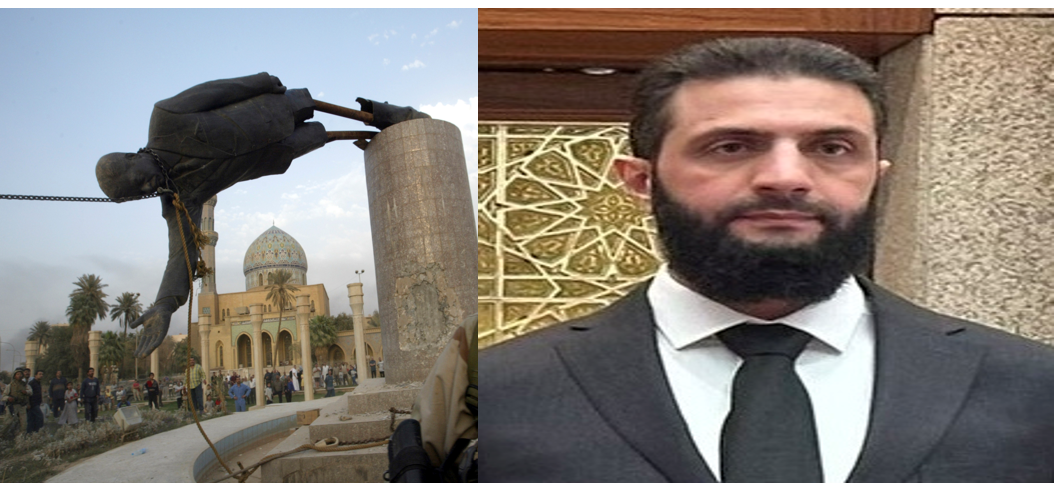


The demise of Saddam Hussein’s Baʿth regime in Iraq in 2003 and Bashar al-Assad’s Baʿth regime in Syria in 2024 were the most sweeping changes in the Middle East during this century. This essay will compare these events by posing the following questions: What are the similarities and differences between the collapse of the two regimes? What are the challenges and dilemmas they faced? What is the impact of the neighboring countries and the West on the new regimes? What are the implications for Israel?
The Similarities and Differences Between the Collapse of the Two Regimes
The events in Iraq and Syria exemplify the change in the minority-majority map of the Middle East. In both cases, it was not a mere change of the bureaucrats at the helm of power like in Tunisia or Egypt for example in the aftermath of the "Arab Spring." Rather it was an ethno-political-social change whereby the political minorities became the hegemonic power. In Iraq the Shiʿi majority that had been politically marginalized since the state’s inception was suddenly thrust into power in 2003. In Syria, the Arab Sunni majority that was marginalized for some sixty years is trying to reclaim political power.
Still, there is a big difference between the collapse of the two regimes. While in Iraq it was by means of war and occupation by external forces, in Syria the collapse was more "natural" and due to internal developments, as well as because the external powers Iran and Russia withheld their support for Assad. Another very important difference is in the way the two regimes were dismantled. In Iraq the allies dissolved the ruling Baʿth party and the army thereby leaving a huge vacuum that led to chaos and which played into the hands of terrorist groups like al-Qaeda and the Islamic State (IS). By contrast, in Syria, Ahmad al-Shara did not apply such radical measures hence there has not been a serious uprising by members of the ex-establishment.
The Sunni Arab minority in Iraq and that of the Alawi minority in Syria, both ruling the state in the name of the Baʿthist pan-Arab ideology, used an iron fist to control the majority.[1] Therefore, the obvious question now is whether majority rule in Iraq and Syria will help bring greater self-confidence, stability, legitimacy, and pluralism to the two countries.
The Challenges and Dilemmas Facing the Two Countries
From what can be observed from the past two decades in Iraq and from what is taking place in Syria since December 2024, it seems that despite the upheaval, there is more continuity rather than a dramatic change in the mode of governance and the regime's legitimacy. The explanation for this lies in the lack of experience of the new rulers, rampant corruption, the absence of democratic values, and a built-in fear of other minorities. Another important factor is the takeover of the mechanisms of government by terrorist organizations: in Iraq, al-Hashd al-Shaʿbi (the Popular Mobilization Forces) with its various offshoots, and in Syria, Hayʾat Tahrir al-Sham (Organization for the Liberation of the Levant or HTS), which has received a complete makeover in the West.
In fact, the two post-Baʿth regimes face similar challenges and similar dilemmas: What kind of regimes should they establish? Authoritarian or democratic, federative or centralized? Should they integrate minorities in the state system? If so, how? How should they address the massive socio-economic problems resulting from the long period of war civil strife?
Both regimes claim they were introducing democracy on the rubble of the collapsed dictatorships they replaced. But in both cases democracy has been in name only. Iraq has established a framework of a democratic system comprised of a constitution, a parliament, and free elections. In practice, it is clearly a dysfunctional democracy. An Iraqi scholar described the situation in Iraq as follows: "The parties have become family mafias, the elections turned into a joke with the outcomes dictated and known in advance and the country is facing the danger of infrastructural collapse."[2]
As to Syria, a sham democracy was established there over the past year. A parliament was set up, in which al-Shara appoints one third of its members. There is no real electoral process and three regions, two Kurdish and one Druze, are not allowed to participate.[3] Another similarity is that in both countries there was a shift from Baʿth regimes that were avowedly secular to regimes led by Islamists.
In both countries there are severe internal conflicts within the new ruling group and outside it as well. In addition to the wars against al-Qaeda and the Islamic State, in Iraq there is an ongoing internal struggle within "the Shiʿi house" (al-bayt al-Shiʿi). Thus, for example, the opposition of Muqtada al-Sadr and his strong nationalist party to the Shiʿi establishment has often reached the point of violent explosion. In Syria the situation is even more precarious as various parties from among the opposition, the Islamic State, and the various minority groups are trying to undermine the new regime and prevent its stabilization.
Another important similarity between the two states is that in both there is a functioning Kurdish entity. The explanation for this unique Kurdish status lies in the weakness of the central government in Iraq and Syria, the Kurds' physical distance from the governing center, the success of both Kurdish communities in establishing ties with the West, as well as their significant roles in the war against the Islamic State between 2014 and 2019. This stands in stark contrast with their Kurdish brethren in Turkey and Iran, where the Kurds enjoy minimal political and cultural rights.
The main demand of the Kurds in Iraq and Syria is to establish a federal system but the government in both countries vehemently oppose this solution. It is true that in Iraq the federal system is anchored in the 2005 constitution. However, since the beginning of its implementation Baghdad has been trying to erode more and more of the Kurdish region's powers. In Syria too al-Shara strongly opposes such a solution.
Syria and Iraq receive strong backing from Turkey and Iran, which fear the repercussions of federated solution and greater Kurdish autonomy on their own governing systems. As for the United States and the West, they seek to use the Kurds as a tool to balance the strength of the ethnic-religious majority governments in Baghdad and Damascus, but Kurdish interests are not a high priority for them. Tom Barrack, the US special envoy to Syria recently came out against the very notion of federated decentralization claiming that it has never worked in the Middle East, including in Iraq.[4]
On the socio-economic and ecological levels, both countries are facing the most serious challenges in their histories. Iraq enjoys enormous potential wealth: One of the world's largest oil reserves, the two rivers, the Euphrates and the Tigris, and a fertile land that used to be the breadbasket of the Middle East. Yet, for all intents and purposes Iraq is considered now one of the poorest countries in the world: Its per capita gross domestic product in 2024 was $4,180.30 (by comparison Israel's was $4,1845).[5] The explanation for this paradox is rooted in years of war, a failed and corrupt leadership, bad management, and poor infrastructure.
Post-Assad Syria has been facing similar problems with the most serious challenge being stabilizing the government. This is against the background of more than a decade of civil war, the death of more than 580,000 Syrians, and 13 million forcibly displaced, and total destruction of the infrastructure and the economy.[6] Another common denominator is that both have to cope with ecological disasters: Shortage of electricity and water, sometimes even for domestic use, desertification, severe sandstorms, high temperatures rising at times to 50 degrees, failing agricultural systems, and mass migration to the cities.
The Impact of External Actors on The New Regimes
Regarding foreign relations, Iraq and Syria project extreme weakness, thus "inviting" external intervention by Turkey and Iran. The chaos and the vacuum that prevailed after the collapse of the old regimes gave impetus to the two neighboring countries to try to dominate the new ones and by extension the countries as well: Iran over Iraq and Turkey over Iraq and Syria.
In their attempt to expand their influence over Iraq and Syria, Turkey and Iran have been using the carrot and stick formula. On the one hand, they present themselves as allies, and on the other hand they exert heavy pressure on them. One example of this is controlling the flow of water in rivers. Thus, Turkey has built 22 large dams and 19 hydroelectric power stations on the Euphrates and Tigris, all of which have caused the drying up of Iraq.[7] These dams have taken a heavy toll on Syria's water system as well.
Concomitantly, Iran is also not sitting by idly. Iran has been employing a two-pronged policy toward Iraq: vengeance for the Iraqi-Iran war (1980-1988) and a creeping invasion of Iraq.[8] Iran too is blocking the flow of water to Iraq, but no less seriously the sale of gas which is critical for daily life in Iraq. Moreover, when Iraq attempted to buy gas from Turkmenistan, Iran signed the deal on its behalf rather than the Iraqi government itself.[9]
It is interesting to compare the methods used by Iran and Turkey for achieving hegemony over their weak neighbors. Iran started its move in Iraq in 2003 and in Syria two decades earlier. As for Turkey, it began spreading its influence in Iraqi Kurdistan with soft power in the 1990s, while in Syria it used military means in the Kurdish areas in northern Syria between 2016 and 2024. The change of regime in Syria presented Turkey with a golden opportunity to expand its influence there in the economic, cultural, political, and military domains.
The most important instrument of power for Turkey and Iran are the proxies they nurture within the security apparatus of each country. Iran did so by controlling al-Hashd al-Shaʿbi in Iraq and Turkey through HTS in Syria. In both cases Iran and Turkey built the relationships with their proxies before the regimes changed in Iraq and Syria.
Turkey and Iran have strong military presence in their neighboring countries. Thus, Turkey has 136 fixed military installations and holds de-facto control of 2000 square kilometers (km) in the Kurdistan Region of Iraq (KRG). It has also built 660 km of roads connecting its facilities. In addition, it established the "forbidden zone" that spans almost the entire Iraqi border with Turkey and is up to 40 km deep in certain places.[10] Turkey has deployed thousands of troops in the KRG, while its air force carries out regular air strikes in the region.[11]
In Syria, Turkey has occupied, with the help of its proxies, large areas in the northwestern part of the country. Kurdish sources claim that since 2016 it has established 200 bases there.[12] This number cannot be verified, but what is certain is that Ankara's freedom of action in Syria under its weak ally al-Shara was enhanced significantly.
Turkey's gains in Syria were Iran's losses. With the demise of the Baʿth in Syria, Iran lost most of its assets there but continued to maintain its power and influence in post-Baʿth Iraq. In addition to penetrating various Iraqi political, economic, and cultural domains, Iran’s hold on the security institutions is still formidable. Since 2003 it has established some 100 militias and armed factions numbering approximately half million as well as a number of military bases.[13] Like Turkey, Iran has targeted the KRG by conducting periodic cross-border artillery strikes including incursions of up 10 km in the region along with attacks by helicopter gunships and unmanned aerial vehicles.[14]
In both cases the US and the West have been playing a crucial role in attempting to reshape the post-Baʿth regimes. The difference though is that in the Iraqi case they were deeply involved in all of the military and political processes that followed the dismantling of the former regime. In Syria, however, the regime’s collapse was "spontaneous", and the West's involvement has been carried out through soft power and diplomacy, without boots on the ground.[15] This raises the question of whether this difference might mean that the US and West will be more welcome by the Syrian population than in Iraq. And will stabilization of the regime be faster as a result of Western support? This remains to be seen.
Implications for Israel
There is a big difference between Iraq and Syria for Israel, and if there is any chance of thawing relations it might be with the latter. The post-Baʿth Iraqi regime is no more open than its predecessor to any relations with Israel. The latest proof is the law which the Iraqi parliament enacted in May 2022 which criminalizes any contact with Israel, not to speak of normalization.[16] Historically speaking, Iraq was the most radical anti-Israeli Arab country: It took part in all the wars against Israel but never paid a heavy price such as losing territory. By contrast, post-Baʿth Syria might be more inclined to reach a certain normalization with Israel for the following reasons: Fear of the still looming Iranian-led Shiʿi axis; the desire to neutralize Israel's influence on the Druze and Kurdish communities; and, the need to restore areas occupied by Israel after the fall of the Baʿth regime in late 2024. Perhaps most importantly, Syria may face pressure from its new ally, the United States.
Conclusions
Both Iraq and Syria are in a long process of searching for a collective identity and direction, and both can be seen as failed states. Likewise, their regimes are a long way from stability and legitimacy.
During the Baʿth era, the two regimes were at each other’s throats, despite ideological similarities. Today, the tension between them stems from sectarian friction: Iraq is ruled by Shiʿis, while Syria is ruled by Sunnis. Furthermore, for all of al-Shara's attempts to blur his past activities, Iraqi Shiʿas have not forgotten al-Shara’s history as al-Qaeda terrorist.
For the last twenty years, the Fertile Crescent, including Iraq, Syria, and Lebanon, has been under Iranian strong influence. However, Iran has lost its hegemony over Syria during the past year. It was also weakened significantly in Lebanon but still maintains its power and influence in Iraq. Accordingly, in the struggle for regional hegemony between Iran and Turkey, the latter is currently the big winner.
In the competition for influence over Iraq and Syria between the United States and the two regional powers, the geographical proximity of the latter gives them the upper hand. Regarding Israel, which was the engine of regional changes, it finds itself challenged by them. Ultimately, it is by no means clear whether the changes in Syria will be in its favor.
Ofra Bengio is a Senior Research Fellow and Professor (Emeritus) at the Moshe Dayan Center (MDC) for Middle Eastern and African Studies, Tel Aviv University. Professor Bengio is also the founder of the MDC’s Kurdish Studies Program.
*The opinions expressed in MDC publications are the authors’ alone.
[1] The Arab Sunnis in Iraq make up approximately 20 percent and the Alawis in Syria approximate 15 percent of the population.
[2] ʿImad Al-Nasiri, "A state without features…Between the failing governments and corrupt parties [Arabic]," Iraq News Network, October 3, 2025. Trump's envoy Tom Barrack presented a very gloomy picture of post-Baʿth Iraq, see: "Lamenting 'balkanization' of Iraq after US intervention, Trump's envoy ignites debate," Amwaj.media, December 9, 2025.
[3] David Gritten, "Syria acknowledges 'shortcomings' in number of seats won by women at election," BBC, October 7, 2025.
[4] “Kurds in Syria reject Trump envoy's claim on decentralization,” Rudaw, December 7, 2025.
[5] Trading Economics, Iraq GDP per capita. https://tradingeconomics.com/iraq/gdp-per-capita.
[6] "Syria: populations at risk," Global Centre For The Responsibility To Protect, November 14, 2025. "Syria's post conflict reconstruction costs estimated at $216 billion," World Bank Group, October 21, 2025.
[7] ʿAlaʾ al-Lami, "The responsibility of Turkey and Iran for the desertification of Iraq [Arabic]," al-Akhbar, July 14, 2022.
[8] For this policy, see: Ofra Bengio, "Vindicating The Poisoned Chalice: Iran's Creeping Invasion of Iraq," Middle East Quarterly 32:1 (Winter 2025).
[9]" Turkmenistan and Iran sign a deal to supply gas to Iraq," Associated Press, July 4, 2024.
[10] Simona Foltyn, "Life inside Iraq's 'forbidden zone' controlled by Turkey," BBC, April 30, 2025.
[11] Amberin Zaman and Jared Szuba, "KRG seeks help to rein in Turkish attacks," Al-Monitor, August 5, 2020.
[12]" Turkey constructs new military bases in north Syria-SDF," North Press, March 27, 2025.
[13] Hudhaifa Ebrahim, "'Not our war': Iran-backed militias in Iraq stay on the sidelines amid Israel War," The Media Line, June 24, 2025. For a detailed discussion on these militias, see: Ofra Bengio, "Vindicating The Poisoned Chalice: Iran's Creeping Invasion of Iraq," Middle East Quarterly 32: 1 (Winter 2025).
[14] Ahmed Ali, Michael Knights, and Michael Eisenstadt, “Iran’s Influence in Iraq,” Policy Watch 1806, Washington Institute for Near East Policy (WINEP), May 6, 2011.
[15] Tom Barrack has recently argued that the US had "balkanized" both Iraq and Syria. "Lamenting 'balkanization' of Iraq after US intervention, Trump's envoy ignites debate," Amwaj.media, December 9, 2025.
[16] "Iraq passes law to criminalize relations with Israel," Al Jazeera, May 26, 2022.