



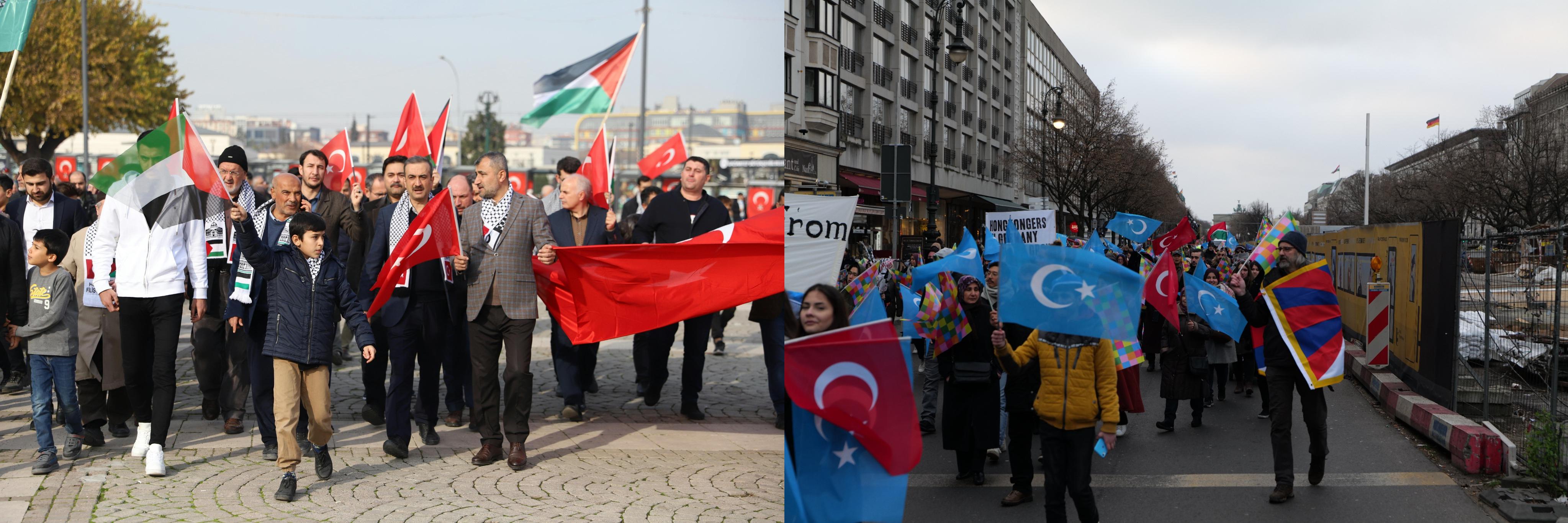

As 2026 begins, Turkey’s foreign policy stands at a crossroads defined by a striking contrast between vocal humanitarian advocacy and strategic silence. While the nation has solidified its role as a leading global voice for the Palestinian cause, framing the war in Gaza as a moral litmus test for humanity, this fervor fades when it comes to the plight of the Uyghur people in Xinjiang. This duality raises a fundamental question about the nature of Ankara's 'principled' stance: why is one struggle championed as a national cause while the other, despite shared Turkic and Muslim bonds, is increasingly treated as a diplomatic liability? The following analysis examines this contradiction, starting with the massive pro-Palestinian display of solidarity on Istanbul’s Galata Bridge and moving on to the complex economic and geopolitical ties that have reshaped Turkey's response to the Uyghur crisis.
On the first day of 2026, hundreds of thousands of protestors gathered on the Galata Bridge in Istanbul to protest the war in Gaza for the third consecutive year. The rally was organized by the Humanity Alliance and the National Will Platform and brought together more than 400 civil society organizations, many of which are closely tied to the ruling Justice and Development Party (AKP). The demonstration was held under the slogan, “We won't cower, we won't keep quiet, we won't forget Palestine,” and was scheduled deliberately after morning prayers, turning the first morning of the new year into a public display of religious-national solidarity.[1]
Speaking at the rally, Bilal Erdoğan, chairman of the Board of Trustees of the Society for the Dissemination of Knowledge (İlim Yayma Cemiyeti) and son of President Recep Tayyip Erdoğan, cast Israel’s military campaign in Gaza as a genocide and evidence of a larger collapse of international moral order. He rejected the conflict as a war between two sides, arguing that the war in Gaza reflected a deliberate policy of annihilation carried out through bombardment, starvation, and the halting of humanitarian aid. He called for national mobilization and urged for boycotts, reparations, and continued pressure against the Israeli government. Quoting the late Bosnian leader Alija Izetbegović, Erdoğan warned the crowd that “A forgotten genocide is bound to be repeated.” [2]
As Turkey has emerged as one of the most vocal international advocates on Gaza in the past several years, Ankara’s silence on the Uyghur question is deafening. The irony is impossible to ignore. In China’s Xinjiang region, Uyghurs - a Turkic-Muslim people whom President Erdoğan himself once described as victims of “genocide” - face mass detention, forced labor, pervasive surveillance, restrictions on religious practice, family separation, and policies aimed at erasing cultural and linguistic identity.[3] Despite the alarming situation of the Uyghurs, Turkish decision makers do not bring the Uyghur question to public attention as they do with the Palestinian case. Turkish non-governmental organizations willfully ignore the suffering of the Uyghurs, while institutionalized media outlets deny the issue a platform in their daily coverage. In short, the voices of the Uyghur people remain unheard within Turkey.
The answer to this paradox lies in what Gaza offers Turkey and the Uyghur issue does not. Gaza is a stage where Turkey can claim regional influence and regime legitimacy. Owing to political ties with Hamas that date back to at least 2006,[4] Turkey has emerged over the years as a primary external patron of the organization. This role solidified as Hamas faced increasing isolation following the 2023 Gaza war and as the regional proxy network of Iran began to weaken.[5] By providing Hamas with room to maneuver throughout the war and acting as a negotiation facilitator to protect the interests of Hamas during hostage-prisoner swaps while hosting released members, Turkey has secured a seat at the table to shape the post war administration of Gaza.[6]
In October 2025, U.S. President Donald Trump named Turkey as one of four guarantors of the Gaza ceasefire alongside Egypt, Qatar, and the United States at the Sharm el-Sheikh Peace Summit.[7] Turkey was further identified as a potential contributor to Gaza’s reconstruction and to an International Stabilization Force authorized by UN Security Council Resolution 2803.[8] This role was formalized in January 2026, when Turkey joined Trump’s newly established Gaza Board of Peace, endorsed by the UN and launched at the World Economic Forum in Davos. Turkey joined alongside Saudi Arabia, the UAE, and Egypt, while most Western allies declined participation.[9] Establishing itself as the “defender of Palestinians” Turkey has secured a foothold in Gaza, more concrete geopolitical leverage, and Erdoğan has bolstered his domestic narrative as the champion of Muslim causes.
Notwithstanding the deliberate silence from Ankara, the Uyghur issue remains the most sensitive point in the relationship between Turkey and China. The Uyghur people predominantly inhabit the Tarim Basin in northwest China, a region historically known as Turkestan before it was renamed the Xinjiang Uyghur Autonomous Region following the rise of the Chinese Communist Party in 1949.[10] Despite the name, the region is fully administered by Beijing and full political authority lies in the hands of the Chinese Communist Party. The term “Xinjiang,” meaning “New Borders,” reflects Chinese sovereignty, while many Uyghur groups prefer “East Turkestan” to emphasize the region’s Turkic identity and earlier periods of Uyghur self-rule.[11] Uyghur identity is rooted in Turkic language, Islamic religious traditions, and historical ties with other Central Asian Turkic populations.
These connections of shared ethnicity and culture explain what once made Ankara one of the Uyghur community’s strongest advocates. Since the 1950s Turkey has provided political asylum to thousands of East Turkestani refugees who have fled China making Turkey home to one of the largest Uyghur diasporas in the world, estimated at around 50,000.[12] In 1995, Erdoğan, then mayor of Istanbul, dedicated a park near the Sultan Ahmet Mosque to Isa Yusuf Alptekin, a leading figure of the East Turkestan independence movement, and described East Turkestan as the “cradle of Turkic history, civilization, and culture.”[13] However, Erdoğan has cut the Uyghurs almost entirely out of his public statements since becoming “strategic partners” with China in 2010 despite increasingly presenting Turkey as the political and cultural leader of the Turkic world.
International reporting and human rights investigations have shown that the eleven million Uyghurs in Xinjiang have been subject to systematic state oppression for decades. According to the UN OHCHR,[14] authorities began intensifying surveillance, political indoctrination, and large-scale arrests after 2014 under the “Strike Hard Campaign,” targeting ordinary religious and cultural practices as “terrorist threats.”[15] This repression escalated around 2017, when Xinjiang authorities built a system of mass detention centers incarcerating up to one million Uyghurs and other Muslim minorities, also subjecting them to forced labor programs, mosque demolitions, and severe restrictions on religious expression.[16] The UN report also documents coercive birth-control measures, family separations, and near-total digital surveillance, concluding that these policies may constitute crimes against humanity.[17] The United States Holocaust Memorial Museum’s 2025 report claimed there are more than half a million people still being held in formal prisons or extrajudicial internment in the country.[18]
Before the countries entered a strategic partnership, Erdoğan spoke more bluntly about the situation with the Uyghurs. In 2009, after ethnic clashes between the Uyghurs and the Chinese Hans in Xinjiang’s capital, Urumqi, left nearly two hundred people dead, then Prime Minister Recep Tayyip Erdoğan described the events as “a kind of genocide.” His statement reflected strong public sympathy, and protests erupted in Istanbul, where demonstrators burned Chinese flags and the Trade and Industry Minister, Nihat Ergun, urged for boycotts of Chinese goods.[19] The statement came at a very different time for Erdoğan as Western governments still praised his “moderate Islamist” leadership and Turkey was making strong strides toward EU membership.
A sharp policy turn in 2015 away from support for the Uyghurs was a consequence of Erdoğan’s shift away from Western allies after he became convinced that the 2013 Gezi protests and a corruption investigation targeting his inner circle was a result of a Western conspiracy against his rule.[20] That summer, despite Turkey seeing weeks of anti-Chinese protest in Istanbul, where demonstrators burned Chinese flags, attacked Chinese restaurants, and in some cases assaulted people whom they believed were Chinese or Chinese tourists, the Turkish government continued to strengthen economic ties with China, lessening its dependence on the West.[21]That same year, a Chinese consortium acquired 65 percent of the Kumport Terminal, Turkey’s largest container port and a strategic link to European shipping routes. China’s ICBC also purchased a majority stake in Tekstilbank, becoming the first Chinese bank to gain full commercial and investment banking licenses in Turkey. These deals arrived at a moment when Turkey faced severe financial pressure, dwindling foreign reserves, and rising debt costs, making Chinese capital one of the few reliable sources of external liquidity.[22]
Against this backdrop, Erdoğan’s visit to Beijing in July 2015 marked a clear shift in Turkey’s position on the Uyghurs as economic alignment took precedence. Although the Turkish media claimed that the visit was organized with the intention of Erdoğan “warning China regarding the oppression of the Uyghurs,”[23] it in fact pursued an entirely economic agenda. Erdoğan was joined by then Economy Minister Nihat Zeybekçi and Energy Minister Taner Yıldız and more than 100 members of the Turkish Foreign Economic Relations Board, while close to 400 Turkish and Chinese business executives joined the Turkey-China Business Forum focused on industry cooperation. Erdoğan’s meetings with President Xi Jinping and Premier of the State Council Li Keqiang focused on strengthening “mutual political trust” and the two countries signed multiple agreements aimed at boosting trade and investment.[24] It was in this context that Erdoğan took a much milder position on the Uyghur issue, publicly affirming the Xinjiang region as an “inseparable part of China,” while dismissing Turkish news reports of Uyghur repression as exaggerated or fake.[25] That same year Turkey joined the Belt and Road Initiative to promote its own Middle Corridor strategy with the hope of boosting exports to China by turning Turkey into a logistics hub between Asia and Europe. The relationship’s expectations were clear: political silence on Xinjiang would be rewarded with more extensive economic investment.
After the sharp Turkish economic downturn following the 2016 failed coup attempt, investors from the Netherlands, Spain, Belgium, Azerbaijan, and Russia all reduced their investment in the country. The national currency depreciated 29% and credit rating agencies continue to rank Turkey as a high-risk country. China again came to the rescue providing Turkey with a loan of 3.6 billion US dollars in 2018 and an additional 6.6 billion US dollars in the following three years.[26] Official financial support was complemented by the high-profile commercial acquisition of a majority stake in Turkish e-commerce company Trendyol by Chinese Alibaba for $750 million in 2018.[27] This strengthening of economic ties accompanied the then Turkish Foreign Minister Mevlüt Çavuşoğlu’s promise to “eliminate any media reports targeting China.”[28] For Erdoğan, maintaining China’s economic support became essential to stabilizing the economy, even if it meant softening public criticism over the Uyghur issue. In short, economic survival took precedence over ethnic partnership.
The first rupture in this delicate relationship came from the nationalist-opposition İYİ Party leader Meral Akşener in November 2022 when she commemorated Uyghur victims of the Chinese Barin Massacre on X, declaring that “East Turkestan will one day be independent.”[29] The Chinese Embassy in Ankara replied with unusual speed and visibility on X the next day, asserting that Xinjiang is an “inseparable part of China” and tagged Akşener.[30]
Even the foreign minister at the time Mevlüt Çavuşoğlu rejected Beijing’s expectations of Turkish complacency directly, accusing China of blocking a Turkish humanitarian delegation from visiting Xinjiang for five years. At an end of year press briefing in 2022, he openly questioned the credibility of Beijing’s claims about Uyghurs cultural rights and asked, “Why should we become a tool for China’s propaganda?”[31]
That line would prove short lived. Following Erdoğan’s loss in the March 2024 local elections, which are considered a potential blueprint for the 2028 general elections, Ankara reasserted its commitment to Chinese investment under public pressure to stabilize the economy. Just two years after Çavuşoğlu’s warning, his successor, Foreign Minister Hakan Fidan visited Urumqi and Kashgar, the symbolic centers of Uyghur life in Xinjiang and adopted precisely the role Çavuşoğlu had rejected. During the trip, he urged “changing the perception in the world and the Islamic world regarding the cultural rights and lives of the Uyghurs,” describing such a change as “beneficial for China, for us, and for everyone.” He also reaffirmed Turkey’s support for “China’s one-China policy, its territorial integrity, and its sovereignty.”[32] This works to completely delegitimize the Uyghur national aspirations and an attempt to appease the Chinese in exchange for increased economic investment.
Turkey’s economic ties with China have continued to grow since the 2010s. By 2022, China had become Turkey’s second-largest source of imports, and Turkey’s Ministry of Foreign Affairs reported that trade reached a 48.3-billion-dollar volume in 2024. [33] This partnership, however, has been somewhat one sided. Turkish exports into China remain at only $3.4 billion resulting in a $41.5 billion trade deficit in 2024. This deficit made up 60% of Turkey’s total trade deficit. [34] In material terms, China now holds a level of economic leverage over Turkey that no Turkic multilateral framework can come close to matching.
The willingness of Turkey to seek out economic growth at virtually all costs further exposes the hollow nature of Turkey’s pan-Turkic message. Since the collapse of the Soviet Union in 1991, Turkey has invested heavily in institutional cooperation among Turkic states to dilute Russian dominance in central Asia and, more recently, to limit China’s expanding economic influence. This culminated in the establishment of the Turkic Council in 2009 through the Nakhichevan Agreement and later rebranded in 2021 as the Organization of Turkic States (OTS). The OTS now includes Turkey, Azerbaijan, Kazakhstan, Kyrgyzstan, and Uzbekistan, collectively representing a population of more than 170 million and a group GDP of over $1.5 trillion. The OTS is designed to turn “common history, common language, common identity, and common culture” into concrete political and economic partnership through regular summits, foreign minister coordination, and a Turkic Investment Fund of $500 million.[35]
Yet, even at its most ambitious, the OTS remains economically marginal against China’s financial reach. Beijing’s Belt and Road Initiative, lending, and direct investment channels in Turkey and Central Asia operate on a scale in tens of billions of dollars, not hundreds of millions. For Ankara, this disparity establishes a clear limit of pan-Turkic solidarity as a symbolic and diplomatic project, rather than one Ankara is willing or able to prioritize when it risks disrupting relations with China.
Despite Turkey’s stated desire to show pan-Turkic leadership, this commitment falls short even when the government is faced with potential economic sacrifice. For example, in 2022, Uyghurs began to be arbitrarily assigned “restriction codes,” a legal mechanism that enabled Chinese repression to seep into Turkish courts without judicial process. Under Law No. 6458 on Foreigners and International Protection (LFIP), the Directorate General of Migration Management (DGMM) is authorized to classify foreign nationals as security risks based on intelligence assessments rather than court rulings. Uyghurs in Turkey have been disproportionately assigned codes such as G-87 (“threat to public order or security”) and Ç-114 (“association with foreign terrorist fighters”), often without arrest warrants, indictments, or criminal convictions.[36] Once imposed, these codes invalidate residence permits, block citizenship applications, restrict employment, require regular police reporting, and allow detention in removal centers pending deportation.[37] Crucially, Turkish authorities are permitted to rely on foreign intelligence to justify these code classifications, including information given by Chinese state institutions. A Human Rights Watch report published in November 2025, documents cases in which Chinese-supplied allegations that are unverifiable and hidden behind claims of state secrecy, were accepted by Turkish authorities as sufficient grounds for imposing restriction codes.[38]
Erdoğan continues to press the concept of the “16 Turkic States,” which explicitly includes the Uyghurs, and promotes Turkey’s leadership role in the OTS as a signal of guardianship over the broader Turkic world. However, his advocacy stops when it would jeopardize needed economic support from China.[39] In the case of the Uyghurs, Turkey has abandoned the one Turkic population whose protection carries real economic costs by risking the already shaky economic relationship with China. The stark contrast between Turkey’s fervent advocacy for Gaza and its calculated reticence regarding the Uyghurs reveals a foreign policy dictated by pragmatism rather than a universal moral compass. By positioning himself as the “defender of the oppressed” in the case of Gaza, President Erdoğan has secured significant geopolitical leverage and reinforced a powerful domestic narrative of Muslim leadership. However, this mantle of guardianship falters at the borders of Xinjiang, where the cost of principle clashes with the necessity of Chinese capital. If Ankara continues to allow economic survival to dictate its conscience, its claim of leadership in the Turkic and Muslim worlds will remain incomplete and insincere.
Martine Panner is a Dual BA student at Tel Aviv University and Columbia University. She won a U.S. State Department scholarship to study for a year in Ankara, Turkey through the YES Abroad program. Her work focuses on Turkish foreign policy and the political use of identity and power in the Middle East.
*The opinions expressed in MDC publications are the authors’ alone.
[1] Hamdi Dindirek and Gizem Nisa Demir, “Galata Bridge Rally in Istanbul Marks Historic Stand for Palestine: Turkish Civic Leader,” Anadolu Agency, January 1, 2026,[Accessed: January 26, 2026].
[2] Ibid.
[3] “Turkish Leader Calls Xinjiang Killings ‘Genocide,’” Reuters, July 11, 2009, [Accessed: January 26, 2026].; “Assessment of Human Rights Concerns in the Xinjiang Uyghur Autonomous Region,” UN Office of the High Commissioner for Human Rights, 2022, p. 7, [Accessed: January 26, 2026].
[4] “Hamas'tan ilk ziyaret Türkiye'ye”, Hürriyet, February 16, 2006, [Accessed: January 27, 2026].
[5] Jonathan Schanzer, Sinan Ciddi, Melissa Sacks, and Michael Rubin, “Hamas and Turkey: Partners in Terror,” Foundation for Defense of Democracies, March 28, 2025, [Accessed: January 26, 2026].
[6] Salim Çevik, “Turkey’s Emerging Role in Trump’s Gaza Plan,” Arab Center Washington DC, December 17, 2025, [Accessed: January 26, 2026].
[7] Ibid.
[8] “US President Donald Trump, World Leaders Sign Gaza Board of Peace’s Official Charter,” The Jerusalem Post (Reuters), January 22, 2026, [Accessed: January 26, 2026].
[9] Ibid.
[11] Ibid.
[12] “Protected No More: Uyghurs in Türkiye,” Human Rights Watch, November 12, 2025, [Accessed: January 26, 2026].
[13] Yitzhak Shichor, “Ethno-diplomacy,” Policy Studies, vol. 53 (East-West Center), 2009, p. 2.
[14] Office of the United Nations High Commissioner for Human Rights
[15] “Assessment of Human Rights Concerns in the Xinjiang Uyghur Autonomous Region,” UN Office of the High Commissioner for Human Rights, 2022, p. 7, [Accessed: January 26, 2026].
[16] “China’s Repression of Uyghurs in Xinjiang,” Council on Foreign Relations, October 3, 2025, [Accessed: January 26, 2026].
[17] Ibid., pp. 35-43.
[18] “Eight Years On, China’s Repression of the Uyghurs Remains Dire: How China’s Policies in the Uyghur Region Have and Have Not Changed,” United States Holocaust Memorial Museum, Simon-Skjodt Center for the Prevention of Genocide, February 2025, p. 1, [Accessed: January 26, 2026].
[19] Quentin Sommerville, “Turkey Attacks China ‘Genocide’,” BBC News, July 10, 2009, [Accessed: January 26, 2026].
[20] Mustafa Akyol, “How China Coopted Turkey to Forsake the Uyghurs,” Current Trends in Islamist Ideology, Hudson Institute, January 26, 2022, [Accessed: January 26, 2026].
[21] Selin Girit, “China-Turkey Relationship Strained over Uighurs,” BBC News, July 9, 2015, [Accessed: January 26, 2026].
[22] Dr. Cüneyt Gürer, “Turkey-China Relations: Economic Needs and Global Desires,” Per Concordiam, November 17, 2022, [Accessed: January 26, 2026].
[23] “Cumhurbaşkanı Recep Tayyip Erdoğan, zulme 'dur' demeye gidiyor”, Yeni Akit, July 5, 2015, [Accessed February 2, 2026].
[24] Mehmet Ali Berber, “President Erdogan in China to boost trade, investement,”Daily Sabah, July 29,2015, [Accessed January 29, 2026].
[25] Galia Lavi and Gallia Lindenstrauss, “China and Turkey: Closer Relations Mixed with Suspicion,” Strategic Assessment, Research Forum, July 2016, p. 123 [Accessed: January 26, 2026].
[26] Filip Noubel, “Turkey’s Uyghur Dilemma in the Context of China’s Belt and Road Initiative,” Global Voices, September 24, 2021 [Accessed: January 26, 2026].
[27] Dan Primack, “Scoop: Alibaba Paid $750 Million for Turkish Startup Trendyol,” Axios, August 14, 2018, [Accessed January 29, 2026].
[28] “Turkey Promises to Eliminate Anti-China Media Reports,” Reuters, August 3, 2017, Accessed January 29, 2026].
[29]Meral Akşener (@meral_aksener), X (Twitter), April 5, 2021, 11:35 AM, [Accessed January 29, 2026].
[30]Embassy of the People’s Republic of China in Turkey (@ChinaEmbTurkiye), X (Twitter), April 6, 2021, 1:25 PM, [Accessed January 29, 2026].
[31] “Turkey’s Erdoğan, China’s Xi Discuss Uyghurs in Phone Call – Turkish Presidency,” Reuters, July 13, 2021, [Accessed January 29, 2026].
[32] Alican Tekingunduz, “Turkish Foreign Minister Urges Changing Perceptions of Uighurs,” TRT World, June 5, 2024, [Accessed: January 26, 2026].
[33] “Türkiye-Çin Halk Cumhuriyeti Ekonomik İlişkileri,” Republic of Türkiye Ministry of Foreign Affairs, [n.d.], https://www.mfa.gov.tr/turkiye-cin-halk-cumhuriyeti-ekonomik-iliskileri.tr.mfa. [Accessed: January 26, 2026].; Veysel Tekdal and Emre Demir, “The Belt, the Corridor, and Roadblocks: Locating the Persisting Trade Deficit in Turkey-China Economic Relations,” Turkish Studies 26, no. 4 (2025): 783.
[34] “Türkiye-Çin Halk Cumhuriyeti Ekonomik İlişkileri,” Republic of Türkiye Ministry of Foreign Affairs, [n.d.], https://www.mfa.gov.tr/turkiye-cin-halk-cumhuriyeti-ekonomik-iliskileri.tr.mfa. [Accessed: January 26, 2026].
[35] “Organization of Turkic States,” Organization of Turkic States, [Accessed January 29, 2026].
[36] “Protected No More: Uyghurs in Türkiye,” Human Rights Watch, November 12, 2025, p. 19, [Accessed: January 26, 2026].
[37] Ibid., p. 20.
[38] Ibid., p. 22.
[39] Gulshat Rozyyeva, “Pan-Turkic Renaissance or Geopolitical Pragmatism?,” The Hague Research Institute, December 21, 2025, https://hagueresearch.org/pan-turkic-renaissance-or-geopolitical-pragmatism/. [Accessed: January 26, 2026].