



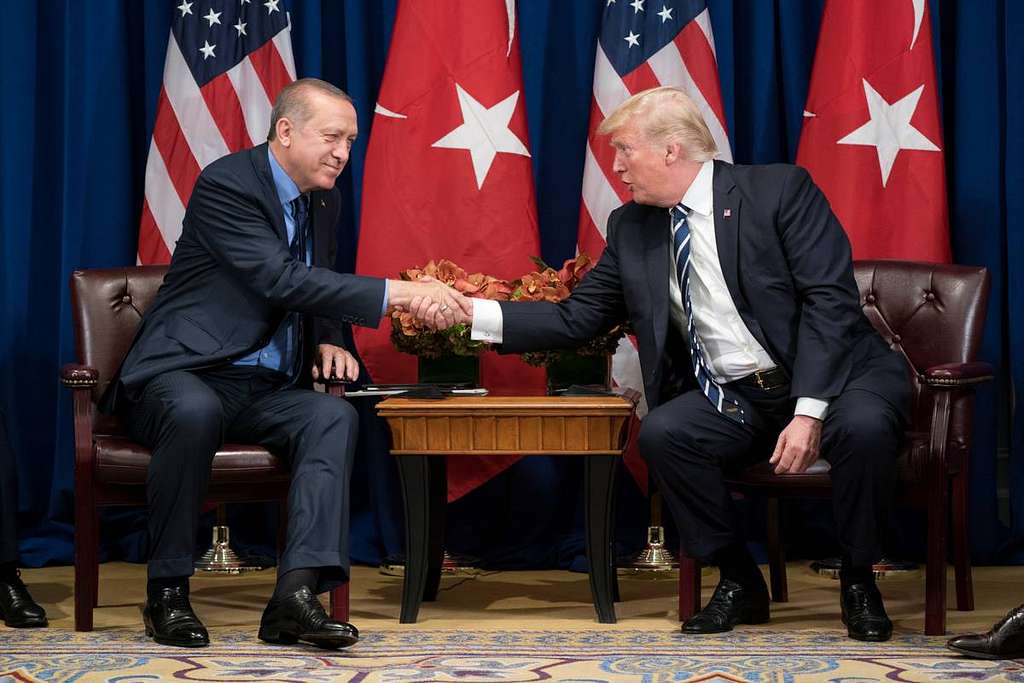
The deterioration of relations between Turkey and Israel following October 7 raised important questions about the potential consequences for relations between Ankara and Washington. Such concerns appeared justified. A Republican controlled Congress remained broadly skeptical of Turkey, influential members of the incoming administration were closely aligned with Israel, and Turkey's economic vulnerabilities seemed likely to provide President Donald Trump with leverage similar to that employed during his first term.
Contrary to these expectations, developments over the following eighteen months produced a different outcome. While relations between Turkey and Israel continued to worsen, with Ankara remaining one of Hamas's most vocal state supporters and intensifying its criticism of Israel, relations between Washington and Ankara improved significantly at the leadership level. President Recep Tayyip Erdoğan's September 2025 visit to the White House, his first in six years, generated progress on several longstanding disputes, including the F-35 program, CAATSA sanctions, and the Halkbank case, while also opening new avenues for cooperation in trade and civilian nuclear energy. President Trump's public characterization of Erdoğan as a "highly respected" and "tough" leader reflected the increasingly personal nature of bilateral ties.[1]
The 2026 Iran war brought this apparent contradiction into sharp focus. Despite declining to participate in the American campaign against Iran and instead positioning itself as a mediator, Turkey largely escaped the public criticism directed at several European allies for their reluctance to contribute. The episode demonstrated both the strategic importance Washington continues to assign to Turkey and the growing tensions inherent in a policy of accommodation toward Ankara.
The dynamic was on vivid display in June 2026. Addressing his party's parliamentary group, Erdoğan escalated further than at any prior point in the crisis, recasting Israel not merely as an aggressor against third parties but as a direct threat to Turkey itself. Israeli operations in Syria and Lebanon, he warned, had reached a point that threatens "not only these two brotherly countries but now Turkey," declaring that Turkish security "begins not only in Hatay, but in Aleppo, Damascus, and Beirut" and vowing that Ankara would never permit the "promised land [Greater Israel]" project to advance.[2] Netanyahu fired back, branding him an "antisemitic dictator."[3] Yet when an Israeli reporter at the White House asked Trump whether Erdoğan's threats might bring the two countries to blows, the president brushed the question aside: "I like Erdoğan a lot. He's a strong person… I don't think that will happen with Turkey, not as long as I'm president, because Erdoğan respects me and I respect him."[4] He declined to engage the reporter's parallel question about selling Turkey F-35s. The exchange captures the relationship's governing logic in miniature: Erdoğan delivers his harshest anti-Israel salvo yet - careful, as ever, to keep Trump personally out of it - and Washington responds not with pressure but with a personal endorsement.
Tolerating Turkish neutrality
The U.S.–Israeli campaign against Iran, launched on February 28, 2026, and preceded by the twelve-day war of June 2025, placed Trump in the position of asking allies to share the burden. Most of them declined. He spent the spring publicly berating European partners.
Turkey, which borders Iran and hosts NATO radar and air assets that intercepted Iranian missiles headed toward the alliance's southern flank, gave Washington even less in operational terms. [5] Ankara declined to join the campaign, called repeatedly for diplomacy, and positioned itself as a mediator alongside Pakistan, Qatar, Egypt, and Saudi Arabia. [6] Yet Erdoğan drew none of the public scolding Trump aimed at the Europeans. On the contrary, Trump has consistently spoken of Erdoğan as a uniquely capable interlocutor – “respected by Russia, Ukraine… and a friend of mine,” as he put it of Turkey's potential role in the Ukraine file.[7] Where European hesitation was treated as freeloading, Turkish neutrality was treated as an asset.
The asymmetry is less puzzling than it looks. Three factors explain why Trump extended Ankara latitude he denied to Berlin and London.
First is geography. Turkey shares a border with Iran, and its concerns about spillover are not rhetorical. A collapsing or fragmenting Iran threatens Turkey with precisely the two contingencies that have caused Erdoğan the most domestic pain: a resurgent Kurdish insurgency with freedom of movement across porous borders, and a new wave of refugees. Ankara absorbed millions of Syrians over the past decade, and the resulting domestic backlash has been a persistent drag on Erdoğan's standing. Iran's northwest, moreover, is home to a large ethnic-Azerbaijani population speaking a language mutually intelligible with Turkish - a community Ankara watches closely and Tehran guards jealously. Turkish intelligence chief İbrahim Kalın warned that the war risked igniting a “ring of fire” pitting Turks, Kurds, Arabs, and Persians against one another.[8]
Second, and relatedly, is the Kurdish question, which produced the war's most striking U.S.–Turkish episode. According to reporting in the Israeli press, a U.S.–Israeli plan to enlist Kurdish fighters for a ground component against Iran collapsed in March 2026. The plan unraveled for several reasons - the operation's premature exposure in U.S. media, Iranian countermeasures, and Kurdish demands for political guarantees after watching Washington abandon the Syrian Democratic Forces - but Erdoğan's intervention featured prominently. Ankara made clear it “would not tolerate Kurdish independence anywhere in the region,” and Erdoğan raised his opposition to using Kurdish forces directly with Trump, who ultimately judged the operation too dangerous.[9] The episode should be read with appropriate caution; the collapse was over-determined, and Erdoğan was one factor among several. But if the reporting is accurate, it fits the pattern perfectly: confronted with the single development most threatening to Turkish security, Erdoğan picked up the phone, and Washington accommodated him.
Third is the personal relationship, the variable that most distinguishes Erdoğan from his European counterparts. Erdoğan has been careful, throughout the Iran crisis, to avoid criticizing Trump by name even while condemning the war - a restraint his domestic opponents have noticed and resented. CHP leader Özgür Özel complained that Erdoğan's refusal to name Trump amounted to a "shy silence" that only "emboldened" the American president and argued that such deference “is not neutrality.”[10] Özel's critique is self-interested, but it is also accurate as a description of Erdoğan's method. Where European leaders lectured Trump on international law, Erdoğan flattered him and worked the back channel.
Why Washington Needs Ankara
The deeper reason Trump tolerates Turkish behavior that would be intolerable in another partner is that Turkey has become, by a process of elimination, one of the few states in the region whose cooperation Washington genuinely cannot do without.
Turkey fields the second-largest military in NATO after the United States, and - crucially - it is one of only a handful of Middle Eastern militaries capable of effectively projecting power beyond its borders, a club that otherwise includes Israel, Iran, and, arguably, Egypt. In a world that has grown markedly more violent and more multipolar, the ability to actually deploy force at distance is appreciating in value, and Ankara has it. That single fact underwrites a long list of files on which Washington needs Turkey.
The most immediate is Syria. Following the fall of Assad, Turkey emerged as the dominant external power shaping the post-war order, backing the new government in Damascus and brokering - through U.S. envoy Tom Barrack - an integration arrangement between Damascus and the Kurdish-led SDF.[11] Whatever one thinks of the terms, the United States cannot stabilize Syria, contain an ISIS resurgence, or manage the Kurdish file without Turkish buy-in.
The second is Ukraine. Ankara has spent three years building genuine mediation credibility: it armed Ukraine while keeping channels open to Moscow, hosted negotiations, and brokered the Black Sea grain corridor. Trump has explicitly named Erdoğan as a mediator he trusts on the Russia–Ukraine file, and as Washington pushes for a settlement, Turkish convening power is an instrument the administration wants to keep.[12]
The third is the alliance itself. As long as NATO matters to U.S. strategy, the bloc's second-strongest member matters too—its bases, its control of the Turkish Straits, its air defense of the southeastern flank, and its weight in any confrontation with Russia.
The fourth is energy and connectivity, the area where Turkish and American interests align most naturally and where the upside is largest. Turkey is the indispensable western anchor of the Middle Corridor, the trans-Caspian route that lets Central Asian and Caucasus exports reach Europe while bypassing Russia and Iran. This is the same architecture - including the TRIPP corridor through southern Armenia - that gives the United States commercial access to Central Asian critical minerals without routing them through Moscow, Tehran, or Beijing. Ankara is also a central player in the Armenia–Azerbaijan normalization that makes the corridor viable, and a natural partner to the expanding bloc of pro-American Turkic states.
That bloc is the most underappreciated growth area in the relationship. In November 2025, Kazakhstan became the first state of Trump's second term to join the Abraham Accords, with Azerbaijan and Uzbekistan reported to be in talks.[13] In January 2026, Kazakhstan, Uzbekistan, and Azerbaijan signed on as founding members of Trump's new Board of Peace - alongside Armenia, Turkey, and the Gulf states.[14] These are precisely the countries drifting away from the Russian–Iranian axis and toward Washington, Jerusalem, and Ankara, and they are increasingly the connective tissue between U.S. Middle East policy and U.S. Eurasia policy. Turkey sits at the center of that map.
As the only country maintaining close ties with both Israel and Turkey, Azerbaijan exemplifies the benefits of deeper U.S. engagement. Baku serves as a strategic bridge between two key American partners. Recent U.S.–Azerbaijan agreements on energy, connectivity, and security have strengthened this role, helping preserve common interests among Washington, Ankara, and Jerusalem despite growing bilateral tensions.
Cooperation across this space also dovetails with the legislative agenda that would unlock it -repealing Jackson-Vanik and Section 907 and authorizing Middle Corridor investment - which is itself gaining momentum as Washington courts Central Asia. The push to scrap Section 907, the 1992 provision restricting U.S. aid to Azerbaijan, has significantly progressed: a repeal bill introduced in December 2025 was initially dismissed as a lone effort, but it has since picked up a steady stream of co-sponsors, several of them pro-Israel Republicans on the House Foreign Affairs Committee who frame repeal as a way to counter Iran and reward a reliable partner.[15]
None of this requires Erdoğan to moderate his posture toward Israel. And that is the point: so long as Turkey toes a line short of genuine rupture, the structural case for the relationship survives almost any amount of anti-Israel rhetoric. Erdoğan understands this better than anyone. His signature skill is timing—knowing when to escalate and when to pocket his gains and wait. He released Pastor Brunson in 2018 once the economic pain became acute; he launched a charm offensive toward Israel and the Gulf in 2021–22 when isolation threatened collapse; he avoided naming Trump throughout the Iran war even as he denounced the campaign. He pressures when pressure is cheap and holds off when it is costly, and he has read the current administration's priorities accurately.
The Barrack Problem
The personification of Washington's accommodation has been Tom Barrack, who since May 2025 served simultaneously as U.S. ambassador to Ankara and special envoy for Syria—an unusually expansive remit that made him, by some accounts, one of the two most influential figures in U.S. regional policy.[16] Barrack's tenure generated a remarkable volume of criticism from across the American foreign-policy establishment, much of it converging on a single charge: that he represented Turkish interests more faithfully than American ones.
The Foundation for Defense of Democracies published an analysis flatly titled “America's Ambassador to Turkey Is Undermining U.S. Interests.”[17] Senate Republicans have criticized Barrack criticizing Israel, downplaying Turkish escalations, for pushing F-35 reinstatement, and for advocating a Turkish role in the Gaza stabilization force.[18] Israeli officials reportedly described him as acting “like a Turkish ambassador.”[19] Sinan Ciddi of FDD noted that Barrack operated with unusual latitude precisely because “he has the ear of Trump.”[20] On Syria specifically, the indictment is largely persuasive: Barrack's brokering of the Damascus–SDF arrangement drew sharp criticism from Kurdish leaders who felt abandoned, and his public musings—that the region is better governed by “benevolent” monarchies than by democracies—were genuine liabilities.[21] On May 30, 2026, Secretary of State Marco Rubio announced that Barrack would step down from the Syria envoy role, though he retains the Ankara ambassadorship and, by most accounts, his broader influence.[22]
But the Barrack critique, however well-founded on individual points, can obscure the structural reality. The administration's interest in good relations with Ankara does not depend on any one envoy's sympathies; it rests on the power-projection and connectivity logic outlined above. Barrack may have tilted further toward Ankara than American interests warranted. The underlying policy of keeping Turkey close, however, is not his invention, and it will outlast him.
When anti-Israelism is anti-Americanism
The danger in Washington's accommodation is that it treats the Israel friction as a manageable irritant separable from U.S. interests. Increasingly, it is not. The weaponization of the Palestinian cause by actors such as Iran has long aimed less at helping Palestinians than at expelling Western influence from the region, and in Turkey the rhetorical machinery aimed at Israel rarely stops at Israel.
The clearest illustration came in February 2026, when an Islamist youth organization erected a public installation outside a school in Antalya depicting Netanyahu, Trump, Bill Clinton, Jeffrey Epstein, and - inexplicably - Michael Jackson seated around a table consuming the organs and blood of Palestinian children, dollar bills strewn across the scene beneath an Israeli flag.[23] The imagery revived the medieval blood libel, and it pointedly placed a sitting American president at the table. Local authorities offered no meaningful condemnation. The episode is a small data point, but a telling one: in the Turkish public sphere, hostility to Israel and hostility to the United States are increasingly the same sentiment, expressed in the same breath.
This is the conundrum Washington has not resolved. The administration has failed to alter the collision course between two of its most important regional partners, Israel and Turkey, and the deterioration is dangerous precisely because it is no longer purely bilateral. But the absence of any serious effort to address the trend leaves the United States exposed to being forced, eventually, to choose.
Washington's Silence on the Opposition Crackdown
If the administration's quiet on Israel reflects strategic triage, its silence on Erdoğan's domestic crackdown reflects something closer to deliberate policy—and it marks the sharpest break from American practice.
Over the past year, Erdoğan's government has waged a sustained legal campaign against the opposition Republican People's Party (CHP), beginning with the jailing of Istanbul Mayor Ekrem İmamoğlu in March 2025, which triggered the largest protests in Turkey in over a decade. The campaign escalated dramatically in May 2026. On May 21, an Ankara appeals court annulled the 2023 party congresses that elected Özgür Özel as CHP leader, declaring them an “absolute nullity” and moving to reinstate his predecessor, Kemal Kılıçdaroğlu—a figure the AKP finds more manageable.[24] Three days later, more than a hundred riot police stormed CHP headquarters in Ankara, using tear gas and pepper spray to evict Özel and his supporters; days after that, police broke up a rally in Izmir with water cannon.[25] Human Rights Watch called the court order the latest "deeply damaging blow" to Turkish democracy, and even the pro-Kurdish DEM Party condemned it.[26] The CHP had been polling roughly even with the AKP.
Washington said essentially nothing. When İmamoğlu was first arrested, Trump-administration officials characterized it as a Turkish "domestic issue" of no concern to the United States.[27] The Congressional Research Service noted, in carefully measured official language, that the second Trump administration has “outwardly welcomed closer relations with Turkey” while "possibly downplaying" controversial domestic matters.[28] By the time the CHP leadership was removed and its headquarters stormed, the silence had become a settled posture. Özel went so far as to ask publicly whether Erdoğan had obtained permission “from across the ocean” before moving against him—a charge that is almost certainly false but that captures how the opposition reads American quiet: as tacit endorsement.[29]
The contrast with recent precedent is stark. As vice president, Joe Biden traveled to Istanbul in 2016 to criticize Erdoğan's treatment of journalists and academics to his face. As a candidate in 2020, Biden called Erdoğan an “autocrat” and urged support for Turkey's opposition to defeat him “by the electoral process.”[30] One need not admire the results of that approach to notice the difference. More striking still, even Trump's own first administration acted when Turkish repression crossed onto American soil: in 2017, the State Department summoned Turkey's ambassador after Erdoğan's security detail attacked protesters in Washington, declaring that the United States “does not tolerate” violence used to stifle free speech.[31] The same administration that summoned an ambassador over a street brawl in 2017 has, in 2026, declined to comment on the dismantling of Turkey's main opposition party. That is a measure of how far the relationship's center of gravity has shifted toward transaction.
Prospects
Stripped of the alliance framework that has both bound and constrained the relationship for seventy years, the two states would deal with each other as the transactional partners their leaders already are. In some respects that would suit both: Erdoğan has long chafed at NATO's strictures, and Trump's instinct is to treat alliances as deals rather than commitments. A more à la carte relationship - cooperation on Syria, Ukraine mediation, energy, and the Turkic bloc, with Israel quarantined as a disagreement - is in many ways the relationship that already exists beneath the formal architecture.
But the more likely near-term trajectory is continuity. At the current pace, the United States is not going to downgrade its relationship with Turkey, because the areas of cooperation - Syria and regional security, Ukraine, NATO's southeastern flank, and Eurasian energy and connectivity - are too valuable and too hard to replace. Even continued Turkish attacks on Israel are unlikely to change this calculus, provided Erdoğan stays on the right side of the lines that would genuinely alarm Washington: choking off the flow of Azerbaijani and Kazakh oil through the pipelines that supply Israel, moving militarily against a U.S. partner, or openly hosting Hamas's senior leadership. Erdoğan, who has spent two decades calibrating exactly how far he can push before incurring real cost, knows where those lines are.
The result is a relationship that is simultaneously warmer at the top and hollower underneath than it was when I last wrote. The personal rapport between Trump and Erdoğan is real and productive; so is the structural case for cooperation. What is missing is any American willingness to spend that goodwill on the two problems it is best positioned to influence—the collision between Turkey and Israel, and the steady strangulation of Turkish democracy. Tolerance and transaction can sustain a relationship for a long time. They cannot, by themselves, keep it from drifting somewhere neither party intends.
Joseph Epstein is the Director of the Turan Research Center in Washington, D.C., a Senior Fellow at the Yorktown Institute, and a Research Fellow at the Begin-Sadat Center for Strategic Studies at Bar-Ilan University. A veteran of the Israel Defense Forces, he speaks fluent Russian and Hebrew.
Ayan Serikpayev is a Research Assistant at the Turan Research Center and an International Relations undergraduate at Maqsut Narikbayev University.
*The opinions expressed in MDC publications are the authors’ alone.
[1] Türkiye Today, “‘Historic' Trump–Erdogan Meeting Ends with Nuclear Deal, Boeing Purchase, Progress on F-35s and CAATSA,” September 26, 2025; Gavin Blackburn, “Trump Signals to Erdogan That US Could Lift Ban on F-35 Sales,” Euronews, September 25, 2025.
[2] “Erdogan: Israel’s strikes on Lebanon and Syria threaten Turkey,” Times of Israel, June 10, 2026.
[3] Ibid.
[4] Ibid.
[5] “Turkey's Erdogan Says Iran War Must Stop Before Whole Region Dragged In,” Reuters, March 11, 2026.
[6] Matthew Byrza, “Could Turkey Help Mediate an End to the Iran War?” Atlantic Council, March 31, 2026; “Turkey's Erdogan Tells Trump Issues with Iran Can Be Resolved, Ankara Says,” Reuters, May 20, 2026.
[7] Matthew Byrza, “Could Turkey Help Mediate an End to the Iran War?” Atlantic Council, March 31, 2026.
[8] Itamar Eichner, “Turkey Says It Blocked Alleged Israeli Plan to Recruit Kurdish Fighters for Iran War,” Ynetnews, March 30, 2026.
[9] Times of Israel, “US-Israeli Plan for Kurdish Invasion of Iran Reportedly Collapsed Amid Leaks, Distrust,” March 29, 2026; Itamar Eichner, “Turkey Says It Blocked Alleged Israeli Plan to Recruit Kurdish Fighters for Iran War,” Ynetnews, March 30, 2026.
[10] “Turkey's Erdogan Says Iran War Must Stop Before Whole Region Dragged In,” Reuters, March 11, 2026.
[11] Al Jazeera, “Rubio Says Trump Envoy Barrack to Step Down from Syria Post,” May 30, 2026.
[12] Matthew Byrza, “Could Turkey Help Mediate an End to the Iran War?” Atlantic Council, March 31, 2026; Tim Zadorozhnyy, “Turkey 'Ideal Host' for Peace Talks on Russia-Ukraine War, Erdogan Says,” Kyiv Independent, February 18, 2026.
[13] Joseph Epstein, “Kazakhstan Joins the Abraham Accords—and Redefines the Geography of Peace,” Atlantic Council, November 7, 2025; Frud Bezhan and Reid Standish, “Why Is Kazakhstan Joining the Abraham Accords?” RFE/RL, November 7, 2025.
[14] Andrei Matveev, "Kazakhstan, Uzbekistan, and Azerbaijan Join Trump-Initiated Board of Peace," The Times of Central Asia, January 26, 2026; Aliya Haidar, “Jackson-Vanik Repeal Gains Momentum as U.S. Courts Central Asia,” The Times of Central Asia, February 2, 2026.
[15] Yerepouni News, “Section 907 – Why It Should Be Repealed,” April 21, 2026; Mark Temnycky "Congress Can Boost US Trade and Strike a Blow to Iran with Azerbaijan's Help," The Hill, March 19, 2026; and H.R. 6534, 119th Congress (introduced December 10, 2025).
[16] Marc Rod, “Lawmakers Alarmed by Barrack's Turkey Tilt in His Middle East Diplomacy,” Jewish Insider, February 17, 2026; Clotilde Bigot, “US Special Envoy to Syria Tom Barrack to Step Down,” The National, May 30, 2026.
[17] Sinan Ciddi and Jonathan Schanzer, “America's Ambassador to Turkey Is Undermining U.S. Interests,” Foundation for Defense of Democracies (FDD), April 24, 2026.
[18] Marc Rod, “U.S. Ambassador to Turkey Tom Barrack Faces Renewed Condemnation for Anti-Israel, Pro-Ankara Comments,” Jewish Insider, April 2026; Emily Jacobs, “Tom Barrack's Controversial Comments on Israel, Turkey Confounding GOP Lawmakers,” Jewish Insider, December 10, 2025.
[19] Middle East Monitor, “Israel Accuses US Envoy to Syria of Defending Turkish Interests,” December 10, 2025.
[20] Emily Jacobs, “Tom Barrack's Controversial Comments on Israel, Turkey Confounding GOP Lawmakers,” Jewish Insider, December 10, 2025.
[21] Sinan Ciddi and Jonathan Schanzer, “America's Ambassador to Turkey Is Undermining U.S. Interests,” Foundation for Defense of Democracies (FDD), April 24, 2026; Clotilde Bigot, “US Special Envoy to Syria Tom Barrack to Step Down,” The National, May 30, 2026.
[22] Al Jazeera, “Rubio Says Trump Envoy Barrack to Step Down from Syria Post,” May 30, 2026.
[23] Combat Antisemitism Movement, “Grotesque Antisemitic Blood Libel Display Erected Outside School in Turkey,” February 19, 2026; Itamar Eichner, “Graphic Display in Turkey Depicts Netanyahu, Trump Eating Organs of Palestinian Children,” Ynetnews, February 18, 2026.
[24] Cagla Uren & Gavin Blackburn, “Turkish Court Annuls Leadership of Main Opposition CHP Party, Sparking Turmoil,” Euronews, May 21, 2026; Ezki Arkin, “Turkish Court Ousts CHP Leadership Amid Opposition Crackdown,” Al-Monitor, May 22, 2026.
[25] Emre Basaran & Sait Burak Utucu & Sertaç Aktan, “Turkish Police Storm Main Opposition Headquarters with Tear Gas,” Euronews, May 24, 2026; AFP/Courthouse News, "Police Fire Tear Gas to Break Up Turkey Opposition Protest," May 26, 2026.
[26] Human Rights Watch, “Türkiye: Court Removes Leadership of Main Opposition Party,” May 22, 2026; Huseyin Hayatsever, “Turkey's Pro-Kurdish Party Condemns Ousting of Main Opposition,” Reuters, May 25, 2026.
[27] Ragip Soylu, “What's Erdogan's End Game with Imamoglu's Arrest?” Middle East Eye, March 2025; The Cipher Brief, “As Turkey Faces Mass Protests, Trump and Erdogan Map New Relationship,” June 2025.
[28] Congressional Research Service, “Turkey (Türkiye): Major Issues and U.S. Relations,” updated September 2025 [link to PDF].
[29] Bloomberg, “Turkish Opposition Asks Erdogan If US Approved Rival's Arrest,” April 2026 [Paywall].
[30] Karen DeYoung, “Biden Criticises Crackdown on Dissent in Turkey,” Gulf News, 2016; Al Jazeera, “Turkey Condemns Biden's Criticism of Autocrat Erdogan,” August 16, 2020.
[31] Associated Press, "State Dept. Summons Turkey Envoy After Violence Against Anti-Erdogan Protesters," May 18, 2017.