



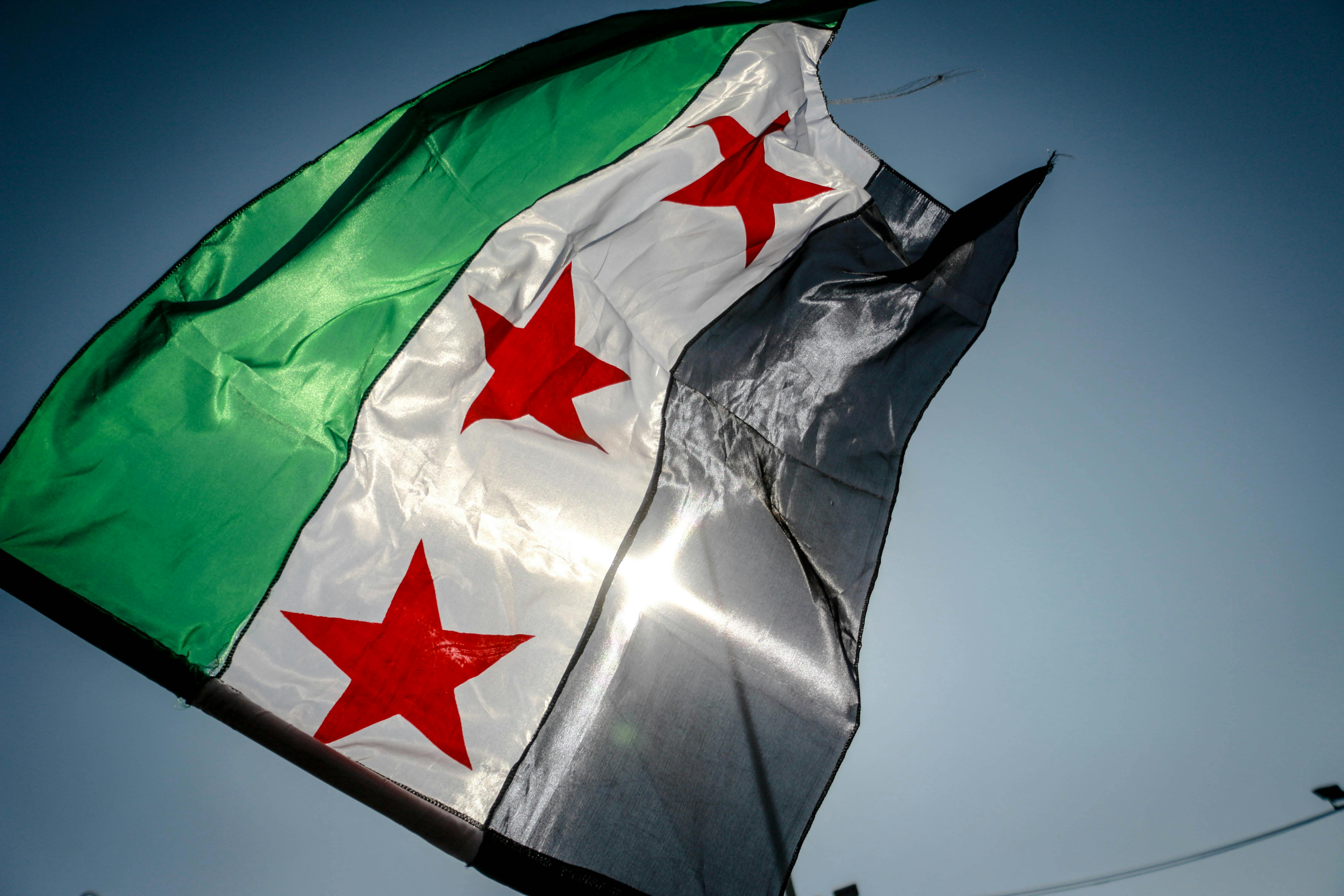
In December 2024, Ahmad al-Sharaa led Hayʾat Tahrīr al-Shām (HTS) in a lightning strike from Idlib to Damascus that forced Bashar al-Assad from power - realizing one element of the dream Syrians first dared to voice on March 15, 2011. Since emerging as de facto leader, al-Sharaa has established a parliamentary government with limited civil participation. As Zoe Levornik notes,[1] the resulting cabinet is drawn predominantly from like-minded Sunni Muslim Arab men, though notable minorities and a few women have been appointed. Al-Sharaa has promised nationwide elections within four years.[2] His seizure of the northeastern third of Syria, previously controlled by the Kurdish-led Syrian Democratic Forces (SDF), can be read as a step toward territorial unification - though Fabrice Balanche and other skeptics interpret the erosion of Kurdish autonomy and the 2025 violence against Alawi and Druze minorities as signs of coercive state-building likely to worsen over time.[3]
This article takes a cautiously optimistic view by incorporating socio-economic factors alongside political and security dimensions. The working assumption is that Syrians who have endured the Assad regime and fifteen years of civil war want Syria to become a modern Weberian state - one that holds a monopoly on the legal use of force across its territory. Two areas where the transitional administration is attempting to demonstrate tangible progress are energy and education. A brief conclusion will address challenges ahead while identifying positive trends that pessimists tend to overlook.
Analysts assessing al-Sharaa’s government have focused largely on two questions: whether violence is declining and whether political inclusion is advancing. Both matter, but they risk obscuring a more fundamental issue - whether al-Sharaa’s government is building a state or merely administering territory. A recent UN report was sharply critical of the security situation, characterizing the transition as a redistribution of violence rather than a genuine turn toward peace.[4] As J. P. Nettl argued, a state is not simply a government that holds power; it is an institution citizens recognize as autonomous from any particular ruler, that establishes clear authority over public goods, and that gradually acquires popular legitimacy.[5] By that measure, energy and education are not peripheral concerns - they are precisely where stateness either takes root or fails, the daily interactions through which ordinary Syrians decide whether Damascus represents something larger than the men currently running it.
Electricity and education are collective goods that everyone values and that are essential to any advanced economy. If the state can deliver only a few hours of power daily, as is currently the case, and if education fails to unlock human potential, broader indicators of state effectiveness - reduced violence, political participation - will likely remain depressed. Meanwhile, al-Sharaa’s government exercises direct or indirect control over most internationally recognized Syrian territory, creating an opportunity for functional stateness at levels unseen since the early 2000s.
Under Hafiz and the early years of Bashar al-Assad, Syria functioned as a structurally flawed but durable authoritarian state that delivered rural electrification, mass public employment, and nationalist legitimacy. Bashar’s post-2000 neoliberal “authoritarian upgrading” hollowed out the Baʿth Party’s social base, concentrated patronage in the ruling clan, and abandoned the regime’s populist constituency in favor of crony capitalists - sowing the conditions for the 2011 uprising.[6] Having survived that uprising through massive repression and external support from Iran and Russia, the regime progressively cannibalized the state itself, replacing unreliable intermediaries with personal “front networks” of ghost businessmen who funneled revenues directly to the presidency, leaving over 90 percent of Syrians in poverty while insulating the inner circle from both economic collapse and diplomatic pressure.[7]
Energy
Ahmad al-Sharaa pledged early in 2025 to increase electricity production.[8] External investment has since roughly doubled Syria’s total generation - from 1.6 to over 3 megawatts - largely through a gas deal with Jordan involving Qatari LNG. Yet the estimated minimum for 24/7 supply would require well over 6.5 megawatts.[9] Before the revolution, Syria theoretically produced about 9.5 megawatts, though consumers routinely experienced an average of forty-three days of outages annually. Eleven of Syria’s fourteen power stations ran on oil or natural gas; three aging stations rely on hydropower from dams built with Soviet assistance.[10]
During the civil war, infrastructure was destroyed and too dangerous to repair. Rebel-controlled areas gradually outpaced the regime’s - a divergence visible in satellite imagery, where regime territory appeared conspicuously dark.[11] Initially, rebel-held areas turned to private generators and solar panels, mainly serving commercial users.[12] Between 2022 and 2024, Turkish and Syrian companies connected major population centers in rebel territory to the Turkish power grid, raising consumer prices but proving cheaper than diesel generators for some businesses.[13] Solar installations have since proliferated across Damascus rooftops as well.[14]
Since al-Sharaa’s pledge, several regional actors - Saudi Arabia, the UAE, Turkey, and Qatar - have announced investment initiatives. Most significant is a $7 billion agreement concluded in May 2025 for solar and natural gas facilities involving Qatar’s UCC Holding, US-based Power International, and Turkey’s Cengiz Enerji. The Emirati firm Dana Gas also reached a preliminary arrangement with the Syrian Petroleum Company to examine rehabilitation of several natural gas fields, including the large Abu Rabah field southeast of Homs. Reviving the oil and gas sector could reduce Syria’s reliance on imported petroleum, ease chronic electricity shortages, and help satisfy domestic demand.[15] These deals have enabled LNG to flow from Jordan as of early 2026,[16] with some supply originating from Israeli offshore sources.[17]
Citizens and business owners have nonetheless complained of skyrocketing electricity prices. The government’s current pricing scheme - announced, notably, on Facebook - subsidizes 60 percent of costs for households consuming up to 150 kilowatt hours monthly, barely enough for a refrigerator, basic lighting, and occasional fan use. Consumption beyond that threshold triggers unsubsidized rates, leaving many Syrians with bills exceeding $50 despite receiving only six to eight hours of power daily.[18] Those requiring heavier appliances increasingly rely on private diesel or solar cooperatives, while businesses often pay for both state electricity and private generators simultaneously.
Syria’s new government has surprised observers with the speed of its move to revive the oil and gas industry. On May 14, 2025, Crown Prince Mohammed bin Salman introduced Trump to al-Sharaa, rapidly warming US–Syrian relations. In June, al-Majallah published an article by Hussein al-Sharaa - the transitional president’s father, an economist and petroleum scholar who spent a decade in Saudi Arabia’s oil sector - spelling out the investment returns available even if Syria’s pre-2011 production of around 300,000 barrels per day were merely restored, with the potential for significantly more gas.[19] Following Trump’s May promise to lift sanctions, an executive order removed many of them on June 30.[20] Three US companies quickly produced a “masterplan” for Syrian energy in July 2025,[21] and Saudi firms subsequently offered to cooperate in reconstructing the electricity grid and restoring oil output to pre-2011 levels.[22]
Energy also appears to have been a key driver behind the US decision to press the Kurdish SDF leadership to capitulate to Damascus.[23] US Special Envoy Tom Barrack celebrated the transfer of oil infrastructure from the SDF to Damascus on January 20, 2026.[24] Regional investors were only willing to work with al-Sharaa’s government - a calculation that came at the Kurds’ expense, as Trump made barely implicit when he noted that the Kurds had been “paid well” for their years fighting the Islamic State,[25] days before the Syrian government retook eastern Syria.
In February 2026, following the capture of the northeast, the Syrian government ordered small oil extractors across the countryside to shut down, and security forces destroyed sites of those who refused.[26] The pattern is revealing: the transitional government is asserting a state monopoly over resources - a necessary condition of stateness - but doing so through personal diplomacy, foreign patronage, and ad hoc enforcement rather than autonomous institutional procedures. The involvement of al-Sharaa’s brother Hazem, a PepsiCo executive, in a government meeting in Riyadh in February 2025[27] underlines how concentrated decision-making remains, posing risks alongside the sector’s genuine promise.
Education
The energy economy is key to generating revenue for public investment, including education. Without adequate state funding, building Syria’s human capital is impossible. Gauging the severity of current conditions - and whether improvement is keeping pace with need - remains difficult. Teachers’ salaries have reportedly roughly tripled from Assad-era levels, yet pay remains around $90 per month in rural areas and $150 in cities, provoking strikes particularly in the north.[28] Thousands of teachers fired during the civil war have been reinstated,[29] though many former Assad-era educators protest that they are being rehired as new temporary employees without recognition of prior experience.[30]
Physical conditions are also dire. Parents complain that children return home ill from schools with missing walls, bullet-pocked masonry, or fabric sheets hung between classrooms.[31] An estimated 7,000 schools were damaged during the civil war, and very few are connected to the electricity grid. No comprehensive national plan to revitalize school infrastructure has yet been implemented, and hygiene problems persist where schools lack clean water and separate bathroom facilities for boys and girls.[32]
The civil war destroyed an educational system that had been central to regime legitimation. Under Hafiz al-Assad, textbooks featuring the president in various social settings reinforced the cult of personality built up from the 1970s onward. The regime achieved genuine gains in rural literacy, with basic education enrollment reaching 93 percent by 2011 - though the curriculum was designed throughout to consolidate regime authority. After the civil war erupted, textbooks went online for millions of displaced Syrians and increasingly stressed regime claims to protect “peace and order.”[33]
The new curriculum - currently implemented without textbooks - foregrounds the Quran and Hadith.[34] How this framework applies to Alawi, Druze, Sunni, and Shiʿi students remains unclear, let alone to minorities with no Quranic tradition. In the weeks before the government’s violent incursion into Suweida following attacks on government forces, reports emerged of Druze and Alawi students being harassed on major university campuses, prompting many to return home and abandon their studies.[35] The government moved to address the situation, though underlying tensions likely remain. In short, education is a mixed picture where improving conditions for students and teachers remains a priority, but curating content for an ethnically and religiously diverse population poses enormous challenges - ones the government has thus far navigated chiefly by not addressing them directly.
Missing from most discussions of curriculum and minority rights are the liberal and secular Syrians - many of them Sunni Arabs such as Suhair al-Atassi, Fidaʿa al-Hawrani, and Sadiq al-ʿAzm - who joined the 2011 revolution precisely because they envisioned a civic rather than a religious national identity. For them, a curriculum anchored in Quran and Hadith is not a neutral baseline but a signal about whose revolution this ultimately was. Secularists including Michel Kilo and Yassin al-Haj Saleh were not opposed to Baʿthist-era achievements in rural literacy or female education, but they wanted a pluralist system that acknowledges differences rather than papers over them. As Saleh has observed, there is no “Sunni majority” in the sense that Sunni Arabs themselves are sharply divided “by class and regional origin, as well as various levels and types of belief and belonging” - let alone Syria’s non-Sunni and non-Arab populations.[36]
Conclusion
In quantifiable terms, Syria is slowly reassembling. Economic output is up, violence is down in most areas, and foreign investment has arrived at a pace unimaginable two years ago. An Alawi official in Latakia recently stated emphatically about his province since March 2025: “We have no major crimes or kidnappings… The security situation is 100% good.”[37] While specific incidents of violence in Latakia and Suweida marred 2025, the overall incidence of violent events in Syria has fallen significantly since the fall of the Assad regime.[38]
Major challenges remain: al-Sharaa has been targeted for assassination several times; deep mistrust between his government and the Druze of Suweida is unresolved; and the Kurds’ unfulfilled demand for a federal arrangement is a continuing reminder that liberation and legitimacy are not the same thing.
The evidence suggests the transitional government has so far built a government more than a state. Electricity pricing is announced on Facebook. Curriculum reform defaults to a religious framework that speaks naturally to some Syrians and alienates others. Teachers are rehired as temporary employees rather than absorbed into a functioning civil service. These are not simply resource problems that investment will solve. They reflect the fundamental challenge facing any post-revolutionary authority: translating military victory and territorial control into institutions that citizens across sectarian and ideological lines recognize as their own.
Joel D. Parker is a Researcher at the Moshe Dayan Center (MDC) for Middle Eastern and African Studies, Tel Aviv University.
*The opinions expressed in MDC publications are the authors’ alone.
[1]Zoe Levornik, “One Year into the ‘New Syria’: Between Promises and Reality,” Alma Research and Education Center, December 23, 2025, https://israel-alma.org/special-report-one-year-into-the-new-syria-between-promises-and-reality/
[2]“New Elections Could Take Up to Four Years, Syria Rebel Leader Says,” BBC News, December 29, 2024, https://www.bbc.com/news/articles/c4g29e1lejvo.
[3]Fabrice Balanche, “The Abandoned Syrian Kurds,” Conflits, January 24, 2026, https://www.fabricebalanche.com/en/kurdistan-en/the-abandoned-syrian-kurds/
[4]United Nations Human Rights Council, Independent International Commission of Inquiry on the Syrian Arab Republic, Report, March 2025, https://www.ohchr.org/en/hr-bodies/hrc/iici-syria/report-coi-syria-march2025
[5]See J. P. Nettl, “The State as a Conceptual Variable,” World Politics 20, no. 4 (July 1968): 559–592. Nettl argues that “stateness” - the degree to which a state is recognized by its citizens as an autonomous institution distinct from the individuals who happen to govern it- varies significantly across societies and is not reducible to the existence of a government or the exercise of coercive power. Stateness is not equivalent to liberal democracy, but a well-functioning democracy would likely require some meaningful degree of it.
[6]Raymond Hinnebusch, “Syria: From ‘Authoritarian Upgrading’ to Revolution?,” International Affairs 88, no. 1 (January 2012): 95–113.
[7]Karam Shaar and Steven Heydemann, “Networked Authoritarianism and Economic Resilience in Syria,” Brookings Institution, August 26, 2024, https://scholarworks.smith.edu/mes_facpubs/17/.
[8]Reuters, “Four Firms Including Qatar’s UCC to Expand Syrian Power Grid,” May 28, 2025, https://www.reuters.com/world/middle-east/four-firms-including-qatars-ucc-expand-syrian-power-grid-2025-05-28/
[9]Marina Marhej, Waseem al-Adawi, and Amir Huquq, “Soaring Electricity Bills: Power Costs Squeeze Syrians and Test the New Government,” Enab Baladi, February 8, 2026, https://english.enabbaladi.net/archives/2026/02/soaring-electricity-bills-power-costs-squeeze-syrians-and-test-the-new-government/
[10]European University Institute, Syria’s electricity sector after a decade of war – A comprehensive assessment, European University Institute, 2021, https://op.europa.eu/en/publication-detail/-/publication/74ee981a-11e1-11ec-b4fe-01aa75ed71a1/language-en.
[11]Nathan Ruser, “Just Look at the Lights: Assad’s Territory Was Growing Poorer as Opposition’s Economy Advanced,” The Strategist (Australian Strategic Policy Institute), December 11, 2024, https://www.aspistrategist.org.au/just-look-at-the-lights-assads-territory-was-growing-poorer-as-oppositions-economy-advanced/
[12]Aaref Watad, “Rebel-held Syria Shifts Power — toward Solar,” AFP, July 4, 2021, https://www.arabnews.com/node/1888091/amp
[13]Levant24, “Return of Electricity: Hope for the People of Idlib,” May 23, 2023, https://levant24.com/articles/2023/05/return-of-electricity-hope-for-the-people-of-idlib/
[14]YouTube, TechAltar, “What 14 Years of Isolation Did to Syria’s Technology,” September 25, 2025, https://www.youtube.com/watch?v=NDHZTuPDnzg.
[15]“Syria’s Energy Sector Set to Get a Boost after Kurdish Oilfield Takeover,” The National, January 21, 2026,https://www.thenationalnews.com/business/energy/2026/01/21/syrias-energy-sector-set-to-get-a-boost-after-kurdish-oilfield-takeover/
[16]“Syria, Jordan Sign Gas Supply Deal to Bolster Syrian Power Grid,” Reuters, January 26, 2026, https://www.reuters.com/business/energy/syria-jordan-sign-gas-supply-deal-bolster-syrian-power-grid-2026-01-26/
[17]This is a problem for many players in the region, since Israel and many other gas suppliers had to pause production during the war with Iran. See: “Gas Producer Energean Halts Israel 2026 Outlook as Mideast War Shuts Production,” Reuters, March 19, 2026, https://www.reuters.com/business/energy/gas-producer-energean-halts-israel-2026-outlook-mideast-war-shuts-production-2026-03-19/
[18]Marina Marhej, Waseem al-Adawi, and Amir Huquq, “Soaring Electricity Bills: Power Costs Squeeze Syrians and Test the New Government,” Enab Baladi, February 2026, https://english.enabbaladi.net/archives/2026/02/soaring-electricity-bills-power-costs-squeeze-syrians-and-test-the-new-government/
[19]Hussein al-Sharaa, “Syria’s Oil and Natural Gas Fields Offer Opportunities for Investors,” al-Majallah, June 2025, https://en.majalla.com/node/325886/business-economy/syria%E2%80%99s-oil-and-natural-gas-fields-offer-opportunities-investors
[20]Holland & Knight, “Executive Order Terminates Syria Sanctions, Directs Actions to Remove Other Trade Restrictions,” July 3, 2025, https://www.hklaw.com/en/insights/publications/2025/07/executive-order-terminates-syria-sanctions.
[21]“US Firms Working on Masterplan to Rebuild Energy Infrastructure in Syria,” The Arab Weekly, July 2025, https://thearabweekly.com/us-firms-working-masterplan-rebuild-energy-infrastructure-syria
[22]“Saudi Firms Sign Agreements to Develop Syrian Oil and Gas Fields,” Arab News, December 10, 2025, https://www.arabnews.com/node/2625701/business-economy..
[23]This is inferred from statements and deals made soon after the US made it clear it would not oppose al-Sharaa’s takeover of northeast Syria. For a short summary see Elfadil Ibrahim, “Was Sharaa’s Offensive on the SDF all about Energy?” The Arab Weekly, February 2, 2026, https://thearabweekly.com/was-sharaas-offensive-sdf-all-about-energy
[24]Tom Barrack (@USAMBTurkiye), “The greatest opportunity for the Kurds in Syria right now lies in the post-Assad transition under the new government led by President Ahmed al-Sharaa,” X (formerly Twitter), January 20, 2026, https://x.com/USAMBTurkiye/status/2013635851570336016.
[25]Forbes Breaking News, “‘I Like The Kurds’: Trump Says United States Is ‘Trying To Protect’ Them Amid Clashes In Syria,” January 20, 2026, https://www.youtube.com/watch?v=FEI6dKWFcuA
[26]Qalaat al-Mudiq, February 16, 2025, X (formerly Twitter), https://x.com/QalaatAlMudiq/status/2023422384490070135
[27]Timour Azhari and Feras Dalatey, “Syria Is Secretly Reshaping Its Economy. The President’s Brother Is in Charge,” Reuters, July 24, 2025, https://www.reuters.com/investigations/syria-is-secretly-reshaping-its-economy-presidents-brother-is-charge-2025-07-24/
[28]Qalaat al-Mudiq, February 16, 2025, X (formerly Twitter); https://x.com/QalaatAlMudiq/status/2023422384490070135?s=20
[29] Timour Azhari and Feras Dalatey, "Syria Is Secretly Reshaping Its Economy. The President's Brother Is in Charge," Reuters, July 24, 2025, https://www.reuters.com/investigations/syria-is-secretly-reshaping-its-economy-presidents-brother-is-charge-2025-07-24/
[30]“The Grandest Walkout in the North: Unprecedented Teachers’ Protests Demand Justice and Fair Pay,” https://syrianobserver.com/society/the-grandest-walkout-in-the-north-unprecedented-teachers-protests-demand-justice-and-fair-pay.html, The Syrian Observer, November 11, 2025.
[31]“Syria Rebuilds Schools, Expands Digital Education,” Arab News, January 4, 2026, https://www.arabnews.com/node/2620947/middles-east.
[32]“The State of Education in Syria,” SARD NGO, 2025, https://www.sardngo.org/blog/the-state-of-education-in-syria
[33]Muhammad Masud, “Authoritarian claims to legitimacy: Syria’s education under the regime of Bashar al-Assad,” Mediterranean Studies 26, no. 1 (2018): 80–111.
[34]Dominique Soguel, “New Syria Revises Its School Curriculum: What’s In, What’s Out,” Christian Science Monitor, October 27, 2025, https://www.csmonitor.com/World/Middle-East/2025/1027/syria-education-curriculum-reform-national-identity
[35]“Syria Govt Clamps Down on Sectarian Incitement at Universities,” The New Arab, May 11, 2025, https://www.newarab.com/news/syria-govt-clamps-down-sectarian-incitement-universities
[36]Robin Yassin-Kassab, “Syria Needs a Strong Society, Not a Strongman,” New Lines Magazine, January 23, 2025, https://newlinesmag.com/argument/syria-needs-a-strong-society-not-a-strongman/
[37]Aymenn Jawad Al-Tamimi, “Coastal Alawite Perspectives: Interview with a Media Activist,” Substack, March 13, 2026, https://www.aymennaltamimi.com/p/coastal-alawite-perspectives-interview?triedRedirect=true
[38]“Sectarian Violence Threatens Syria’s Chance at Stability,” ACLED, December 11, 2025, https://acleddata.com/report/sectarian-violence-threatens-syrias-chance-stability.