



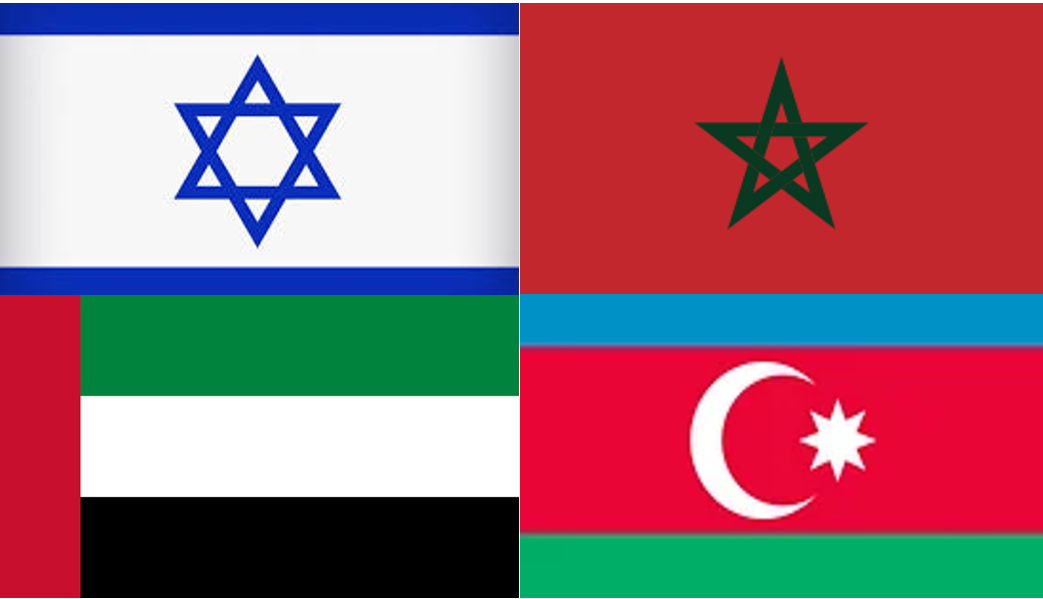

This article examines Israel’s relations with the UAE (2004-2020), Azerbaijan (2011-2022), and Morocco (2009-2023). In each case, relations with Israel followed the same pattern: a national transition to a knowledge-based economy produced a dual foreign policy in which economic and technological cooperation advance alongside, and independently of, security alignment.[1] The article also evaluates the resilience of these relationships under the stress of the Hamas-Israel war from October 7, 2023.
These three Muslim-majority states are from geographically disparate regions – the Gulf, the Caucasus, and the Maghreb. Despite their different strategic contexts, histories, and domestic political environments, they have strengthened ties with Israel along the same foreign policy trajectory.
The UAE: Vision 2021 and the Road to the Abraham Accords (2004-2020)
Prior to formal normalization, UAE-Israel relations evolved covertly within the broader context of the Arab-Israeli conflict. The UAE’s founding father, Sheikh Zayed, maintained the traditional Arab position – shaped by the Khartoum Conference’s "three No’s" of 1967 – that peace with Israel was conditional on resolution of the Palestinian question. His death in November 2004 was a turning point: his heirs, Khalifa Bin Zayed and Mohammed Bin Zayed Al Nahyan, replaced many senior officials and re-examined the UAE’s foreign policy priorities.[2] Covert forms of cooperation had already begun to surface before the transition: technological cooperation in the security field commenced in 2006 with the secret Eros A and B satellite deal; in 2008, Abu Dhabi’s Critical National Infrastructure Authority signed an $816 million contract with AGT International, a Geneva-based company owned by Israeli businessman Mati Kochavi, for surveillance equipment for the UAE’s oil and gas fields; and bilateral trade, conducted through third-party channels, was estimated to have exceeded $1 billion by the mid-2000s. These covert connections coexisted with a public posture that still referred to the “Israeli occupation” in UAE speeches to the United Nations.[3]
The UAE’s transformative policy moment was the 2010 launch of Vision 2021, a national development plan shifting the economy from oil dependency to a diversified knowledge-based model, with targets across innovation, education, healthcare, and digital economy, and soft power and global connectivity placed at the center of external strategy.[4]
Services exports grew 5.5-fold between 2004 and 2020, the ease of doing business ranking improved by 29 places, and the sports and cultural budget expanded by a factor of 22.8. In 2024 the UAE reached a score of 60.85 out of 70 in the Global Knowledge Index. UN General Assembly speech analysis shows references to economic cooperation and technology rising consistently, while Arab-Muslim solidarity references declined - confirming the shift to a knowledge-oriented foreign policy posture.[5]
The implications for UAE-Israel relations were sequential. A secret satellite deal in 2006 marked the beginning of covert technical cooperation, and bilateral trade exceeded $1 billion annually by 2016. Cultural and sporting cooperation became increasingly public from 2010 as neoliberal foreign policy reduced political costs.[6] By 2019-2020, the UAE had withdrawn from Yemen, lifted Qatar sanctions, and signed the Abraham Accords — the formal culmination of a sixteen-year knowledge-based economy driven process. The Iranian threat provided permissive conditions; Vision 2021, followed by vision 2030, were active drivers.[7]
Azerbaijan: From Oil to Knowledge, 2011-2022
Azerbaijani-Israeli relations began in 1992 with Turkey’s assistance, making Azerbaijan the third Muslim-majority state to form relations with Israel after Turkey and Egypt. Despite Israel opening an embassy in Baku in 1993, Azerbaijan declined to reciprocate, preferring covert and limited engagement conducted almost exclusively at the government-to-government level. During the period from 1992 to 2010, relations were structured around three pillars: Azerbaijan’s purchase of Israeli military equipment to support its war effort in Nagorno-Karabakh; an oil trade relationship; and US and Israeli diplomatic lobbying on Azerbaijan’s behalf in Washington. Arms imports from Israel for the entire 1992–2010 period amounted to only $28 million. Azerbaijan’s first president, Abulfas Elçibey, articulated the transactional logic plainly: “Israel could help Azerbaijan in [the] Karabakh problem by convincing the Americans to stop the Armenians.”
Azerbaijan’s pivotal policy moment was the 2011 launch of “Azerbaijan 2020: Look into the Future,” a strategy to diversify from oil toward a knowledge-based economy, targeting intellectual property protection, digital infrastructure, education quality, and innovation capacity.[8] It came after nearly two decades in which military alignment against Iran had been the dominant logic for the bilateral relationship with Israel; the 2011 plan introduced a new, parallel one.
Azerbaijan showed steady post-2011 improvements in information and communication technology imports, education expenditure, and innovation indicators. Most strikingly, the Ministry of Education budget increased by 36,377 percent between 2009 and 2020.[9][10]
Trade in knowledge based economy-associated categories with Israel surged: chemicals by 456 percent, precision instruments by 206 percent, and machinery by 102 percent.[11] Arms imports from Israel grew from $28 million (1992-2010) to $860 million (2011-2022), though the arms trade alone cannot explain expansion into educational, agricultural, and digital cooperation.[12] The establishment of a Technion-affiliated cybersecurity center in 2022, the Azerbaijan-Israel Chamber of Commerce in 2013, and the 2022 embassy announcement indicates a relationship that clearly went beyond the security alignment that preceded it.
Morocco: Subaltern Realism, Neoliberalism, and the KBE, 2009-2023
Morocco's ties with Israel are among the oldest and most complex of any Arab state, rooted in geopolitical positioning, the unique history of its Jewish communities, and secret diplomacy that long predates formal normalization. Morocco's Cold War alignment with the West, and its rivalry with revolutionary socialist Algeria, created parallel interests with Israel from the 1960s onward. As early as 1959, Crown Prince Hassan was encouraging Arab intellectuals to abandon the goal of annihilating Israel and work toward dialogue. Israeli security assistance provided after Hassan's accession helped stabilize his position and facilitated the orderly emigration of Morocco's Jewish community to Israel in the early 1960s, sustaining a unique human bridge between the two states. In 1976, Hassan hosted a secret meeting with Israeli Prime Minister Rabin; in 1977, he moderated secret talks between Israeli Foreign Minister Dayan and Egyptian Deputy Prime Minister al-Tuhami, directly laying the groundwork for Sadat's visit to Israel and the Camp David Accords. In 1986, he publicly hosted Prime Minister Peres in Rabat. Following the Oslo Accords, Morocco established low-level diplomatic relations with Israel in 1994, though it made clear that further progress depended on advances in the Israeli-Palestinian track. When the Second Intifada broke out in 2000, Morocco severed official ties, maintaining only informal contact. Thus, despite deep and sustained engagement, the relationship prior to 2009 remained limited in scope, conducted mainly between governments, and carefully shielded from public view.[13]
Morocco’s knowledge-based transition proceeded through three national plans: the 2009 National Education Emergency Program; the 2012 Maroc Innovation Initiative; and the 2013 Digital Morocco plan targeting ICT infrastructure and digital economy expansion.[14] These plans were adopted against a background of longstanding but predominantly covert ties with Israel – rooted in royal-level intelligence cooperation and Morocco’s historic intermediary role[15] – not yet expressed in broad economic or institutional engagement.
EBRD KBE Index data shows Morocco advancing from early-stage to intermediate KBE status between 1999 and 2023.[16] The Ministry of Digital Economy budget grew fifteenfold, Foreign Affairs by 270 percent, and Education by 68 percent.
Agreements in technology transfer, renewable energy, education, and defense followed; Israeli technology companies partnered with Moroccan counterparts; and bilateral engagement expanded significantly from 2013. The Abraham Accords formalized a decade-long trajectory.[17] Morocco's decision to restore ties with Israel in December 2020 was driven by two principal factors: the U.S. offer of recognition of Moroccan sovereignty over the Western Sahara as a direct quid pro quo, and the prospect of technology transfers, investment, and knowledge-based economic partnerships that closer ties with Israel could yield. That this step was taken despite intense domestic opposition underscores the weight Rabat assigned to these twin strategic and economic incentives.
Post-October 7 Dynamics: Stress Tests and the Resilience of Normalization
The outbreak of the Hamas-Israel war on October 7, 2023 introduced unprecedented stress tests to all three bilateral relationships. While public outrage and regional instability caused notable halts in public-facing diplomacy, the underlying strategic and economic frameworks - particularly bilateral trade and security cooperation - have demonstrated significant resilience.
The UAE-Israel relationship faced significant public strain but avoided rupture. Public opinion polls indicated that the vast majority of Arab respondents viewed the UAE’s position on the war negatively, seeing Israel primarily through the prism of the Palestinian cause.[18] Consequently, there was a visible halt in the public promotion of new UAE-Israel initiatives, and the UAE-Israel-Jordan Water-for-Energy deal was officially suspended by Jordan in November 2023 due to the conflict.[19]
Despite this diplomatic cooling, critical economic and security ties progressed. In 2022, Abraham Accords states accounted for 24 percent of Israel’s record $12.5 billion in defense exports - a depth of security interdependency that buffered the political fallout.[20] To bypass Houthi attacks on Red Sea shipping, Abu Dhabi facilitated a vital overland trade route to Israel.[21] When most international airlines cancelled flights to Israel, Etihad Airways and flydubai were the only foreign carriers to consistently maintain direct routes to Tel Aviv, sustaining ongoing tourism and business travel.[22] The UAE also leveraged its diplomatic channels to deliver humanitarian supplies to Gaza and signaled readiness to participate in a temporary international mission to restore order.[23]
Azerbaijan’s trajectory was the most unequivocal: the relationship actively deepened without any significant halt, underpinned by a robust arms-and-energy architecture. The strategic energy partnership intensified; despite external pressures, Azerbaijan continued to supply oil to Israel, with 40 percent of Israel’s crude oil imports sourced from Baku, rising 28 percent in the first half of 2024 alone.[24] In March 2025, SOCAR acquired Israeli drilling licenses to extract natural gas from Israel’s Mediterranean coast - a major strengthening of energy ties and the only such agreement concluded by a state energy company from a Muslim-majority country in the post-October 7 environment.[25]
In exchange for energy security, Israel remains one of Azerbaijan’s most critical suppliers of advanced defense technology, including multi-billion dollar contracts for systems such as the Barak MX surface-to-air missiles, instrumental in modernizing Azerbaijan’s forces.[26] Reflecting the deepening of these ties despite regional conflict, by early 2025 Israel, the United States, and Azerbaijan were engaged in active discussions to create a formal trilateral cooperation framework spanning security, energy, and diplomacy.[27] Throughout this period, Azerbaijan continued to voice support for the Palestinian cause in multilateral forums – sustaining its characteristic dual-track approach.
In Morocco, the post-October 7 environment caused a severe halt in the public momentum of normalization, driven by overwhelming civil society backlash. Continuous protests took place across major Moroccan cities demanding the severing of ties with Israel.[28] In response, the Moroccan state adopted a cautious middle-ground approach: while the public advancement of Abraham Accords normalization effectively stalled, arms transfer agreements and defense coordination with Israel continued to solidify strategic alignment and Morocco did not close its diplomatic mission in Israel throughout the war.[29]
Official economic data reveal that bilateral trade quietly persisted and expanded. In 2024, Morocco exported $141.55 million in goods to Israel, up from $131 million in 2021: textiles and clothing constituted the largest share at $76 million, followed by sugar products and food preparations at $34.41 million, with automotive parts, electrical equipment, and inorganic chemicals completing the export profile.[30] The Moroccan government carefully avoided revoking the normalization agreement, preserving foundational economic and security ties while issuing condemnations of Israeli military conduct.
Conclusion
The strengthening of ties between the UAE, Azerbaijan, and Morocco with Israel cannot be adequately understood solely through the lens of security alliances. National knowledge-based economy transitions have created structural imperatives that operate independently of, and in tandem with, security alliance logic.[31] This dual foreign policy model explains both the timing and the scope of normalization in each instance.[32]
Israel’s relations with UAE, Azerbaijan and Morocco proved remarkably resilient following the October 7 War. While public pressure caused visible halts in public-facing diplomacy, bilateral trade held or grew in all three cases: the UAE maintained a nearly $3 billion annual trade relationship and operational logistical cooperation with Israel;[33] Azerbaijan deepened its energy partnership with a 28 percent rise in oil exports in the first half of 2024;[34] and Morocco sustained $141.55 million in exports to Israel throughout the conflict.[35] The institutional channels and mutual dependencies built through years of knowledge-based economy cooperation persisted even as the political environment became increasingly challenging.[36] The dual foreign policy pattern is therefore not merely a pathway toward normalization - it is a structural source of its durability.
Daniela Traub is a post-doctoral fellow at the Moshe Dayan Center (MDC) for Middle Eastern and African Studies, Tel Aviv University, a fellow at the Friedberg Economic Institute.
*The opinions expressed in MDC publications are the authors’ alone.
[1]Luvyta Rossa Amaliya, M. H. Basyar, and Muhamad Hannase, “Abraham Accords: Normalization Agreements between Arab Countries and Israel,” Intermestic: Journal of International Studies 10, no. 1 (2025): 23–46.
[2] Daniela Traub, Ronen A. Cohen, and Chen Kertcher, “The Road to Normalization: The Importance of the UAE’s Neoliberal Foreign Policy in the Normalization with Israel: 2004–2020,” Digest of Middle East Studies 32 (2023): 60–78.
[3] Ibid.
[4] Traub, Cohen, and Kertcher, “Road to Normalization,” 60–78.; Joseph S. Nye, Soft Power: The Means to Success in World Politics (New York: PublicAffairs, 2004).
[5] Traub, Cohen, and Kertcher, “Road to Normalization,” 60–78.; M. J. Peterson, “Using the General Assembly,” in The UN Security Council: From the Cold War to the 21st Century, ed. D. Malone (Lynne Rienner, 2006); Yaron Salman, “Tourism and United Arab Emirates-Israel Normalization from the Perspective of International Relations,” The Journal for Interdisciplinary Middle Eastern Studies 12:1 (2025): 73–102.
[6] Sana Al-Eshaq and Ali Bakir, “Dynamic Security Regime: Analyzing UAE-Israel Security and Defense Cooperation Post Abraham Accords,” Alternatives: Global, Local, Political (2025): 1–21.
[7]Traub, Cohen, and Kertcher, “Road to Normalization,” 60–78.
[8] Daniela Traub, Ronen A. Cohen, and Chen Kertcher, “Azerbaijan’s Dual Foreign Policy Strategy toward Israel: A Realist Alliance and a Neoliberal Knowledge-Based Economy Cooperation, 2011–2022,” Cogent Arts & Humanities 11:1 (2024): 2335763.
[9]Afzal and Lawrey, “KBE Frameworks,” 208–218; Traub, Cohen, and Kertcher, “Azerbaijan’s Dual Foreign Policy Strategy,” 2335763.
[10]Majnun Hasanov, “Historical-Political Reasons for the Opening of the Embassy of the Republic of Azerbaijan in Israel,” Acta Humanitatis 3:3 (2025): 163–190.
[11]Traub, Cohen, and Kertcher, “Azerbaijan’s Dual Foreign Policy Strategy,” 2335763.; Stockholm International Peace Research Institute, SIPRI Arms Transfers Database (2023), https://www.sipri.org/databases/armstransfers.
[12]Hasanov, “Opening of the Embassy,” 163–190; Boris Ginzburg, “About Icebergs and Abraham: The Strategic Partnership between Azerbaijan and Israel on Course for the Abraham Accords,” Caucasus Analytical Digest 143 (2025): 15–23.
[13]Daniela Traub, Ronen A. Cohen, and Chen Kertcher, “Morocco’s Dual Realist and Neoliberalism Foreign Policy: An Examination of Morocco’s Decision to Strengthen Ties with Israel, 2009–2023,” Mediterranean Politics 31: 1 (2025): 73–107.
[14]Ibid
[15] Morocco's intermediary role refers to King Hassan II's personal facilitation of secret diplomatic contacts between Israeli and Arab officials. In 1976, he hosted a covert meeting with Israeli Prime Minister Yitzhak Rabin to explore paths to peace; and in 1977 he moderated secret talks between Israeli Foreign Minister Moshe Dayan and Egyptian Deputy Prime Minister Hasan al-Tuhami, directly laying the groundwork for Sadat's historic visit to Israel and the Camp David Accords.
[16] EBRD, Knowledge Economy Index.; Traub, Cohen, and Kertcher, “Morocco’s Dual Realist and Neoliberalism Foreign Policy,” 73–107.
[17] Traub, Cohen, and Kertcher, “Morocco’s Dual Realist and Neoliberalism Foreign Policy,” 73–107.; Mohammed Ayoob, “Inequality and Theorizing in International Relations: The Case for Subaltern Realism,” International Studies Review 4, no. 3 (2002): 27–48. Escude, Foreign Policy Theory.
[18] Arab Center for Research and Policy Studies, Arab Public Opinion about the Israeli War on Gaza (Doha: Arab Center for Research and Policy Studies, 2024).; Jarosław Jarzabek and Marcin Szydzisz, “Israel and the GCC Member States in a Security Architecture of the Middle Eastern Regional Security Complex,” Wschodnioznawstwo 19 (2025): 315–336.
[19] Majed Abu-Zreig and Hussam Hussein, “The Limits of Depoliticized Water–Energy Diplomacy: Insights from the UAE–Israel–Jordan Water-for-Energy Deal,” World Water Policy (2025): 1–18.; M. Al Gebaly and A. Tolba, “Jordan Says It Won’t Sign Energy for Water Deal with Israel,” Reuters, November 16, 2023.; Francesca Fassbender and Udi Sommer, “Environmental Diplomacy: The UAE and Israel before and after October 7,” Strategic Assessment 27, no. 4 (2024): 58–73.
[20] Al-Eshaq and Bakir, “Dynamic Security Regime.”
[21] Dina Esfandiary and D. Jandali, “The UAE, Israel and a Test of Influence,” Crisis Group, June 17, 2024.
[22] Salman, “Tourism and UAE-Israel Normalization,” 73–102.; Shimon Yaish, “The Complete Guide to All Airline Flight Cancellations to Israel,” Israel Hayom, October 14, 2024.
[23] D. Ignatius, “The UAE Tries to Pull Off an ‘Abraham Redux’ in Gaza,” The Washington Post, July 23, 2024.; “UAE Proposes Temporary International Mission to Restore Order in Gaza,” Middle East Monitor, July 26, 2024.
[24] Mehdiyev, “Azerbaijan’s Relations with Türkiye and Israel,” 321–339.; Y. M. Tanami, “Despite Pressure: Azerbaijan Continues to Sell Oil to Israel,” Channel 14 (Israel), February 20, 2024.; Ginzburg, “About Icebergs and Abraham,” 15–23.
[25] A. Khalilova, “Azerbaijan and Israel Strengthen Ties with Gas Exploration Deal,” Euronews, March 19, 2025.
[26] Hasanov, “Opening of the Embassy,” 163–190.
[27] Vasif Huseynov, “Azerbaijan, Israel, and United States Seek Trilateral Cooperation Format,” Eurasia Daily Monitor 22, no. 41 (2025).
[28] Driss Maghraoui, “The Multiple Layers of Morocco’s Normalization with Israel,” in Risks, Resilience and Interdependency (2025): 257–275.
[29] Traub, Cohen, and Kertcher, “Morocco’s Dual Realist and Neoliberalism Foreign Policy,” 73–107.
[30] Issam Toutate, “Morocco Maintains $141.5 Million Trade with Israel despite Public Protests,” Morocco World News, September 11, 2025.
[31] Traub, Cohen, and Kertcher, “Road to Normalization,” 60–78.; Traub, Cohen, and Kertcher, “Azerbaijan’s Dual Foreign Policy Strategy,” 2335763.; Traub, Cohen, and Kertcher, “Morocco’s Dual Realist and Neoliberalism Foreign Policy,” 73–107.
[32] Jervis, “Realism, Neoliberalism, and Cooperation,” 42–63.
[33] Amaliya, Basyar, and Hannase, “Abraham Accords,” 23–46.
[34] Mehdiyev, “Azerbaijan’s Relations with Türkiye and Israel,” 321–339.
[35] Toutate, “Morocco Maintains $141.5 Million Trade.”
[36] Keohane and Nye, Power and Interdependence.