



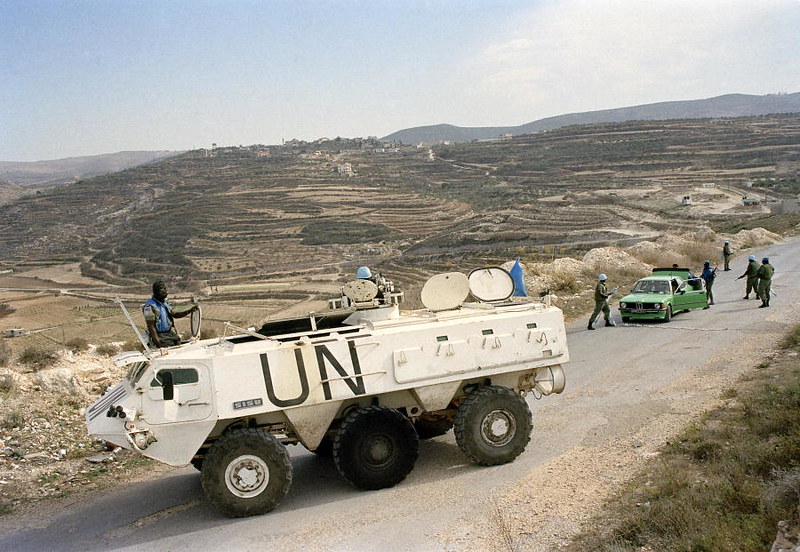
The year 2026 marks the last year of operations for the United Nations Interim Force in Lebanon (UNIFIL). After almost fifty years in place, the United Nations (UN) Security Council decided to discontinue its mandate starting in 2027. This article argues that the force has been unable to fulfill its long-term mission due to a structural difficulty: it has never benefited from local and international consensus necessary for its success.
UNIFIL was created by the Security Council in March 1978. The backdrop was “Operation Litani”, an Israeli invasion of Southern Lebanon aimed at destroying the infrastructure of the Palestine Liberation Organization (PLO) south of the Litani River.[1] Resolution 425, which established UNIFIL, defined the force’s threefold mission: confirming Israel’s withdrawal from Lebanon, restoring international peace and security in the area, and assisting the government of Lebanon in returning its effective authority there.[2] UNIFIL’s original mandate spanned only six months but was later extended periodically until 2025. In August 2025, the Security Council broke from its pattern and adopted Resolution 2790 (2025), which prolonged UNIFIL’s mandate “for a final time” until the end of 2026, effectively terminating the mission in 2027.[3]
The 2024 Israel-Hizballah war served as the trigger for the force’s final abandonment. Long-lasting local criticisms of UNIFIL climaxed in light of that conflict: Israeli and pro-Israeli outlets accused UNIFIL of failing to prevent armed attacks on the Jewish state from Lebanese territory, and of restricting the Israeli army’s freedom of operations in the area.[4] Conversely, Hizballah and some other sources in the Arab world blamed UNIFIL for failing to protect Lebanon from Israeli encroachments, either because it was too weak or because it was tilted to suit Israel’s needs.[5] The Trump administration in Washington, implementing an “America First” policy and cutting back support for international organizations, was happy to ride this momentum and see an end to the almost 50-year-old “interim” force.[6]
While the decision to discontinue UNIFIL was taken in 2025, the obstacles preventing the fulfillment of its mandate date back to its very creation. Political scientists and international relations experts have long examined what makes a peacekeeping operation effective, and many of them point to the importance of local and international support. Namely, a peacekeeping operation depends on cooperation from the belligerents in the field, as well as on declarative and material support from the global community.[7] Much was also written about how UNIFIL has lacked both.[8] However, these sources mainly discuss UNIFIL’s difficulties after it had been created. By contrast, this article returns to UNIFIL’s formative years (1978-1982), to demonstrate that, even before the first peacekeeper set foot in Lebanon, the force never had the necessary consensus to fulfill its long-term missions of “restoring international peace and security” and “assisting the government of Lebanon in ensuring the return of its effective authority in the area”.
Lack of Local Support: the PLO and Israel
In terms of local cooperation, one early problem was posed by the PLO. The organization was initially willing to tolerate UNIFIL’s deployment for the sole purpose of removing Israeli forces from Lebanon in the aftermath of Operation Litani. According to Abdallah Bishara, Kuwait’s representative to the UN in 1978 and a close partner of the PLO’s UN delegation, “The orders of the organization [the PLO] were not to resist anything Lebanon wanted, because the focus was on the withdrawal of the Israeli forces and not getting into details regarding the draft [of Resolution 425]”.[9] However, the organization’s leadership rejected resolutions 425 and 426. Seeking instead to retain its operational freedom throughout Southern Lebanon, the PLO aimed to constrain UNIFIL’s area of deployment and activity.[10] Violent clashes sometimes erupted between the organization and UNIFIL, resulting in UN personnel casualties or injuries.[11]
Israel’s attitude was equally unhelpful. Shortly before the adoption of Resolution 425, Defense Minister Ezer Weizmann told the American Deputy Chief of Mission to Israel Richard Viets that the introduction of a UN force to Southern Lebanon would be “a total waste of time”.[12] In the years preceding Operation Litani, the governments of Yitzhak Rabin (June 1974 – June 1977) and Menachem Begin (June 1977 – August 1981) felt that international peacekeepers would not only prove ineffective in preventing attacks on Israel from Southern Lebanon, but also inhibit Israel’s operational freedom there.[13] After UNIFIL’s deployment, the skeptical Israelis were easily convinced that the force was indeed useless and harmful in that it was overly indulgent in its treatment of the Palestinian guerrillas.[14] The Israelis preferred to rely on the militia of Christian Major Saad Haddad in Southern Lebanon to protect Israel’s northern border, rather than cooperate with UNIFIL.[15] Haddad’s fighters, meanwhile, took a hostile stance against UNIFIL, preventing its stationing inside their enclaves, restricting the force’s movement, organizing protests against the peacekeepers, opening fire at UNIFIL’s positions and patrols, and even encroaching upon the force’s area of operations.[16]
Lack of International Support: The Gap Between Beirut and the International Community
There was no wide support for UNIFIL’s creation on the international level,
Arguably, the only party that truly wanted to see UNIFIL remain in place for many years was the Lebanese government. The 1970s were a troubled time in Lebanon’s history, owing to both an internal civil war that began in 1975 and the Israeli-Palestinian confrontation that unfolded on Lebanese soil. Beirut had lost effective control over major parts of the country, and the Lebanese Armed Forces (LAF) had dissolved as soldiers either fled to their homes or defected to the warring militias.[19] Therefore, the government hoped to “outsource” security across the country. In 1976, Beirut welcomed the Arab Deterrent Force (ADF), a largely Syrian Arab League peacekeeping operation set up to help the Lebanese government reassert authority.[20] Despite effective action elsewhere in Lebanon, the ADF could not be deployed in the south due to Israeli resistance; the Israelis saw the Syrians as a strategic threat and refused to accept a Syrian military presence on their Lebanese border. Through American brokerage, Syria and Israel made a tacit agreement in 1976 known as the Red Line Agreement: Israel would turn a blind eye to Syria’s intervention in Lebanon, in exchange for a Syrian guarantee to keep its units far enough north.[21] When UNIFIL was deployed in Southern Lebanon, Beirut saw it as the long-sought external force that could substitute for Lebanese authority until national reconciliation was achieved.
Conversely, many nations, including even the United States, which sponsored resolutions 425 and 426, saw UNIFIL as a short-term mission to oversee the Israeli withdrawal, soon to be replaced by the LAF.[22] This is why Resolution 426 allocated an initial period of only six months for UNIFIL’s mandate, a remarkably short time in terms of peacekeeping. Officials of the UN and various countries pressed Beirut to promptly reconstruct the LAF to relieve UNIFIL of its duties, or at least to join its efforts in the south, which the government failed to do.[23] After the expiration of UNIFIL’s original mandate in September 1978 and on many subsequent occasions, the Security Council would receive a UNIFIL progress report provided by the Secretary-General, in which he would recommend extending the force’s mandate, to satisfy Lebanon’s wishes. The Security Council would then authorize only a short extension of two to six months until the next review. During these discussions, even countries supportive of Lebanon and UNIFIL, such as the United States, France, and Britain, would express their displeasure that UNIFIL’s mission was still incomplete and that Beirut had failed to assume control of the south.[24] UNIFIL was thus caught between a Lebanese government that embraced it as a long-term solution and an international community that had never committed to one.
All in all, UNIFIL lacked the necessary consensus to carry out its mandate long before 2024. Locally, the force was injected into an active warzone, where the PLO, Israel, and the Lebanese militias had little incentive to accommodate it. International agreement was also unavailable, as the Soviet Union and China refused to back its creation, and even supportive member states took issue with its long-term missions. These disagreements hindered the force’s success, even before other significant problems that many other peacekeeping operations face (for example, a lack of adequate military power or insufficient authority to open fire when necessary). The lack of consensus regarding UNIFIL’s creation and mandate led to an additional problem: a lack of clarity regarding the scope, length, and nature of its mission. Therefore, UNIFIL was doomed from the beginning to be an unpopular and ineffective force.
Jonathan Franco is a postdoctoral fellow at the Moshe Dayan Center (MDC) for Middle Eastern and African Studies.
*The opinions expressed in MDC publications are the authors’ alone.
[1] Bjørn Skogmo, UNIFIL (Lynne Rienner Publishers, 1989), 7–16.
[2] Security Council Resolution S/RES/425, 19.03.1978, the United Nations Digital Library (UNDL).
[3] “UN Interim Force in Lebanon (UNIFIL): Vote on Final Mandate Renewal and Drawdown,” Security Council Report, 28 August 2025, Security Council Resolution S/RES/2790 (2025), August 28, 2025, United Nations Documents (UNDOCS).
[4] For example: Herb Keinon, “UNIFIL’s Failed Role in Lebanon,” The Jerusalem Post, October 16, 2024; Orna Mizrahi and Moran Levanoni, “Time to End UNIFIL’s Mandate in Southern Lebanon?” INSS, May 22, 2025; Asaf Orion, “Lebanon After UNIFIL: Good Riddance, Not a ‘Vacuum’,” The Washington Institute, April 29, 2026.
[5] For example: Iman Ali, “How and Why UNIFIL Failed to ‘Keep Peace’ in Lebanon,” al-Jazeera, November 27, 2024; Amal Khalil, “Lebanon Faces Renewed Blackmail Over UNIFIL Role,” al-Akhbar, June 11, 2025; “As Israel Pushes Past the Litani, Lebanese Question the Purpose of UNIFIL,” al-Jazeera, June 1, 2026.
[6] In explaining the American attitude toward Resolution 2790 (2025), Acting Ambassador to the UN Dorothy Shea stated that it was time to relieve the long-overdue UNIFIL and focus on strengthening the LAF instead. See: Security Council Meeting S/PV.9989, August 28, 2025, 9, UNDL. On Trump’s UN stance more broadly, see: Richard Gowan, “The Trump Administration’s Retreat from the UN,” CEBRI, Year 4, Number 14 (April-June 2025); Joshua Barajas and Dan Cooney, “7 Key Moments from Trump’s U.N. Speech,” PBS News, September 23, 2025.
[7] For example: Lise M. Howard, UN Peacekeeping in Civil Wars (Cambridge University Press, 2008); Virginia Page Fortna, Does Peacekeeping Work? Shaping Belligerents’ Choices after Civil War (Princeton University Press, 2008); Jacques L. Koko and Essoh J. M. C. Essis, Determinants of Success in UN Peacekeeping Operations (Univ. Press of America, 2012); Darya Pushkina et al., ‘Mission (Im)Possible? UN Military Peacekeeping Operations in Civil Wars’, European Journal of International Relations 28, no. 1 (2022): 158–86.
[8] For more on UNIFIL’s challenges, see: Nathan A. Pelcovits, Peacekeeping on Arab-Israeli Fronts (Westview Press, 1984); Ramesh Thakur, International Peacekeeping in Lebanon: United Nations Authority and Multinational Force (Westview Press, 1987); Skogmo, UNIFIL; Karim Makdisi, ‘Reconsidering the Struggle over UNIFIL in Southern Lebanon’, Journal of Palestine Studies 43, no. 2 (2014): 24–41; Chen Kertcher, ‘UNIFIL and the “Security Zone” in South Lebanon, 1985–2000: Traditional Operations in the Post-Cold War Era’, Israel Affairs, 2025.
[9] Abdullah Y. Bishara, Two Years in the Security Council [عامان في مجلس الأمن] (Center for research and studies on Kuwait, 2018), 57–58.
[10] Waldheim-Terzi meeting, March 29, 1978, File S-0899-0013-07-00001, the United Nations Archives and Records Management Section (UNARMS); ‘On the Festival’ [Arabic], al-Safir, December 3, 1979, 4; Emmanuel A. Erskine, Mission with UNIFIL (Hurst, 1989), 25–26; Farouq al-Qaddoumi, Path of the Revolution and Its National Constants [مسار الثورة و ثوابتها الوطنية] (Dar Hanine, 2011), 23–25.
[11]For example: Security Council documents S/12620/Add.2, April 8, 1978, 3; S/12620/Add.4, May 5, 1978, 3-4; S/PV.2164, August 29, 1979, 2, UNDL; Israeli government meeting August 26, 1979, 49-50, Israeli State Archives (ISA).
[12] Tel Aviv to Amman, 19.03.1978, 1978TELAV03714, Central Foreign Policy Files, created, 7/1/1973 - 12/31/1979, documenting the period ca. 1973 - 12/31/1979 - Record Group 59, American National Archives [hereafter: NARA].
[13] For example: “The Israeli Position” [Hebrew], Ma’ariv, March 1, 1977, 1-2; “Peres” [Hebrew], Al Hamishmar, March 2, 1977, 1; Foreign Relations of the United States (FRUS),1977–1980, Arab-Israeli Dispute, January 1977–August 1978, volume VIII, document 81.
[14] Israeli government meeting, 17 June 1979, ISA; Skogmo, UNIFIL, 54–58.
[15] Ezer Weizmann, The Battle for Peace [הקרב על השלום] (Idanim, 1981), 258; Fares Sassin, ed., Letters to President Elias Sarkis [رسائل إلى الرئيس الياس سركيس] (Dar al-Nahar, 1995), 75–76.
[16] For example: Security Council documents S/12845; S/12929; S/13026; S/13691, September 1978-December 1979, UNDL.
[17] Security Council meetings S/PV.2074-2075, 18-19 March 1978, UNDL.
[18] Doha to State, 19.03.1978, 1978DOHA00365, NARA.
[19] Oren Barak, The Lebanese Army: A National Institution in a Divided Society (State University of New York Press, 2009).
[20] The Arab League essentially set up the force to de facto formalize Syria’s military intervention in Lebanon, which had begun earlier. It also slightly enhanced the force with other Arab battalions, but the main bulk of the force remained Syrian. For more on the ADF, see: Istvan S. Pogany, The Arab League and Peacekeeping in the Lebanon (Avebury, 1987), 82–88.
[21] Shimon Golan, ‘The Syrian Consolidation in Lebanon until the 1982 War and Israeli Policy toward It [ההתבססות הסורית בלבנון עד מלחמת שלום הגליל ומדיניות ישראל כלפיה]’, Yesodot 4 (2022): 69–76.
[22] ‘U.S. Seeks Pullout by Israel’s Troops’, The New York Times, March 18, 1978, 1; Skogmo, UNIFIL, 9; Bishara, Two Years, 58.
[23] Kurt Waldheim, In the Eye of the Storm (Weidenfeld and Nicolson, 1985), 191; Selim al-Hoss, The Time of Hope and Disappointment [زمن الامل والخيبة] (Dar al-Alam lil-Malayyin, 1992), 215; Fouad Boutros, Fouad Boutros: The Memoirs [فؤاد بطرس: المذكرات] (Dar al-Nahar, 2009), 285–86; Richard B. Parker, Memoirs of a Foreign Service Arabist (New Academia Publishing, 2013), 240–41.
[24] Yearbook of the United Nations (1978) (UN Department of Public Information, 1981), 295–311; Yearbook of the United Nations (1979) (UN Department of Public Information, 1982), 321–38; Yearbook of the United Nations (1980) (UN Department of Public Information, 1983), 347–58; Yearbook of the United Nations (1981) (UN Department of Public Information, 1985), 283–91; Yearbook of the United Nations (1982) (UN Department of Public Information, 1986), 428–33.