



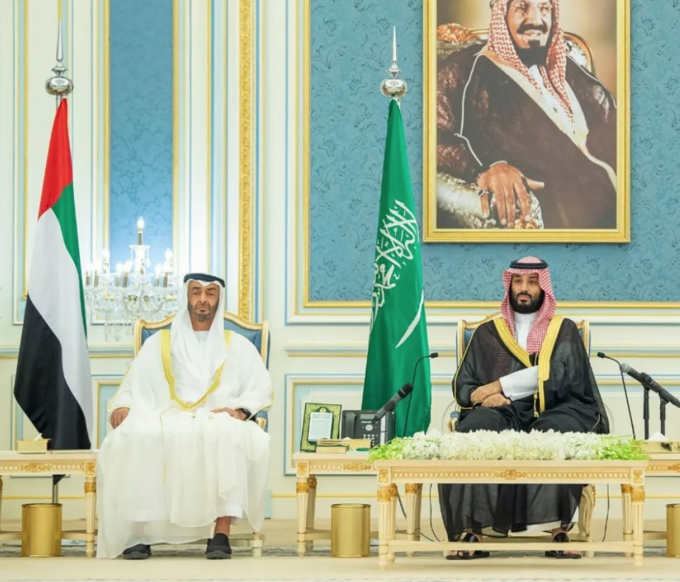

Since the end of 2025, tensions between Saudi Arabia and the United Arab Emirates (UAE) have gained prominence as a major dynamic in regional relations. The February 28 American-Israeli attack on Iran, and Iran’s strong and surprising attacks on the Gulf states and on the UAE with particular ferocity—appear to have led to significant changes in Emirati strategic thinking and policy, which have further highlighted the Riyadh-Abu Dhabi row, but have also led to an even more independent Emirati policy and worldview (including leaving OPEC). This paper lays out the background, context, and direction of this new vector.
The strain in relations between Saudi Arabia and the United Arab Emirates is not new. While the period 2010-2019 saw intimate collaboration between the two states and their Crown Princes on facing the threats posed by the Arab Uprisings, especially regarding Qatar, Turkey, Iran and its proxies, the Muslim Brotherhood and Yemen, tension has existed since at least 2019, when the UAE pulled its troops out of Yemen, which reportedly surprised its Saudi partner.[1] In addition, for the past seven years, Abu Dhabi has grown increasingly frustrated with its restrictive OPEC production quota, which lags far behind its steadily expanding capacity.[2]
Furthermore, starting in 2021, Saudi Arabia began a targeted program to bring more corporate headquarters to the Kingdom. It passed a law requiring that the regional headquarters of any company seeking contracts with the Saudi government must be based in Saudi Arabia. This, of course, was directed against the preference of international corporations and their employees to work out of the much more cosmopolitan and attractive United Arab Emirates. Saudi Arabia has also attempted to challenge the UAE’s role as a global air travel hub by investing significant amounts of money into developing its new airline, Riyadh Air, which will serve as a direct competitor to Emirates and Etihad Airlines. Riyadh has also copied the Emirati economic diversification model by expanding expatriate residency options, opening its property market to foreigners, and recently removing the qualified foreign investor restrictions that heavily limited non-Saudi access to its equity market.
Yemen, Sudan, and Diverging Views Regarding Fragile States
The tension between the two nations reached a peak in December 2025, when the Abu Dhabi-backed Southern Transitional Council (STC) invaded and seized large parts of the Hadhramaut and Al-Mahrah provinces in Yemen. This highlighted a divergence dating back to 2019, when the UAE shifted its focus away from fighting the Houthis toward backing southern separatist actors who could help promote their specific interests. Emirati support for the STC campaign was viewed by Saudi Arabia as a red line.
In January, Riyadh issued a 72-hour ultimatum for the STC to withdraw from Hadhramaut, ordered the UAE to withdraw its troops from Yemen, and bombed a shipment of weapons in the port of Al-Mukalla that it claimed the UAE was delivering to secessionists. Several UAE-linked leaders in Yemen were summoned to Riyadh to pledge allegiance. The STC announced on January 8th in Riyadh that it was dissolving itself. The Saudi airstrikes against the STC and the Mukalla ships marked the first direct military confrontation between the two states. Subsequently, the UAE withdrew its forces from Yemen. This led to severe friction and venomous attacks by social media commentators from both countries.
Even before the Yemen escalation, Saudi Arabia openly criticized the UAE's role in Sudan. Riyadh supported the Burhan-led military government, while Abu Dhabi backed Hemedti’s Rapid Support Forces (RSF). Abu Dhabi officials became convinced that Saudi Crown Prince Mohammed bin Salman had actively lobbied Washington to impose sanctions on the UAE over its RSF ties and discerned a systematic Saudi campaign to tarnish its international image.[3]
Saudi Arabia has also been pursuing strategic cooperation with Somalia and Egypt on Red Sea security.[4] Notably, on January 13th, Somalia canceled all its security, defense, and commercial deals with the UAE, accusing it of violating Somali sovereignty, owing, inter alia, to its agreements with Somaliland over the use of Berbera port and with Puntland over the use of Bosaso port. This followed a diplomatic push by Saudi Arabia.[5] The Somali decision came after Israel became the first country to recognize Somaliland, a move many observers credited to Emirati encouragement (though the UAE has not formally recognized the breakaway republics).
Saudi Arabia and the UAE pursue significantly divergent policies regarding fragile or failing states; Saudi Arabia stresses the sanctity of state sovereignty, while the UAE is willing to promote separatists or opposition elements to advance its own interests. Saudi Arabia appears worried about the UAE aligning with Israel to fragment or destabilize Syria, Somalia, and Yemen.
The UAE for its part sees itself predominantly as a trading nation whose international position and strategic strength are based on connectivity. For this reason it views its ability to influence developments in the Red Sea, especially near the Bab al-Mandab strait, as a strategic necessity. Because it lacks direct geographic access to the area, it seeks to create a system of “forward bases” to project power along this vital trade route. This explains its relationships with Somaliland, Puntland, and the STC, alongside its effort to gain a foothold on Socotra Island in the Arabian Sea and smaller islands in the Red Sea, prospectively securing both sides of the Bab al-Mandab. In addition, Abu Dhabi’s position on most regional issues is clearly anti-Muslim Brotherhood and counter-Islamist, while Saudi Arabia is willing to work with Islamists.
Saudi scholars and influencers argue that UAE policy violates the principle of state sovereignty—which Saudi Arabia claims to respect as a core tenet of its policy—and that Emirati intervention in Libya, Yemen, Sudan, and Somalia has weakened governance across these Arab countries. They contend that by financing separatists and cultivating local militias, the UAE works around fragile national institutions rather than strengthening them. They note that destabilizing policies in Sudan, Somalia, and Yemen impact Saudi Arabia directly due to its geographic proximity, leaving Riyadh to pay the price for its neighbor's adventurism.[6] Some analysts speak of a Saudi feeling of “encirclement” by the UAE. This geostrategic competition is occurring extremely close to Saudi borders and far from those of the UAE, which is shielded by its geography from the direct results of its actions.[7]
Saudi Arabia sees the UAE and Israel as coordinating regional policies in ways that undermine Saudi interests. After the Gaza war, the Israeli strike on Qatar in September 2025, and the U.S.-Israeli attacks on Iran, Saudi Arabia, like many of the other Gulf states, views Israel’s actions as a threat to regional stability.[8] Saudi Arabia views Israel as preferring a patchwork of weak regional neighbors rather than strong, legitimate states, and sees the UAE as sharing this vision. Israel is perceived as being more interested in short-term, visible diplomatic gains (such as normalization) and in shaping a regional architecture that solves its security dilemma, which since October 7 has led to ever-expanding security zones. Both the Emirates and Israel favor pre-emptive activism and early intervention to actively shape their strategic environments, rather than simply managing them. In contrast, Saudi Arabia chooses consolidation, restraint, and threat insulation.[9] This Saudi perception can only have been strengthened by the Israeli and American leaks (ignored or denied by Abu Dhabi) regarding the visits of senior Israeli security officials and Benjamin Netanyahu to the UAE, and the deployment of Israeli air-defense assets and personnel to protect the UAE.
Playing with Blocs?
On an even broader regional geostrategic scale, the bilateral tension is exacerbated by Riyadh’s recent strategy to orient itself with what some analysts term the “STEP” bloc (Saudi Arabia, Turkey, Egypt, and Pakistan). Saudi Arabia has increased its military cooperation—or at least signed cooperation agreements—with Turkey and Pakistan. Turkey has reportedly considered joining a Saudi-Pakistani security framework signed in September 2025, an alignment reportedlyaimed at deterring Israel. Turkish and Saudi policies are currently aligned regarding Sudan, Somalia, and Syria, and the war in Gaza has drawn them closer together.[10]
Theoretically, an opposing bloc exists, composed at its core of the UAE, the US, Israel, and India. The UAE’s recent deepening of relations with India -including a January visit by Emirati President Mohamed bin Zayed Al Nahyan (MbZ) to New Delhi that secured a long-term gas deal for ADNOC, and a mid-May visit yielding security agreements - may be a direct counterweight to upgraded Saudi-Pakistan relations.[11] This builds on long-standing ties rooted in the four million Indian expatriates living in the UAE, alongside frameworks like I2U2 and IMEC. Some observers view the existing tension as a competition between an interventionist “Abrahamic Coalition” (Israel, UAE, Morocco, Greece, India) and an “Islamic Coalition” (Saudi Arabia, Turkey, Pakistan, Qatar, Egypt) that prefers working through existing state structures. This so-called Islamic coalition sees the actions of the “Israeli-Emirati axis” as deeply destabilizing and views support for separatist forces as exacerbating fragmentation.[12] This, perhaps, goes a step too far and overstates the coherence of the two putative groupings.
The reality of these “blocs” is messy. Egypt especially, but also Turkey, remain far more economically dependent on the UAE than on Saudi Arabia.[13] Viewing them purely as members of an anti-UAE “Saudi” camp minimizes the UAE's global economic power; the UAE's GDP is nearly half that of Saudi Arabia, despite the UAE’s having a fraction of the population, and its various sovereign wealth funds are together much richer than Saudi Arabia’s Public Investment Fund (PIF). The UAE has made deft use of strategic investments and currency swaps to embed its influence in the economies of Egypt and Turkey.
Sibling Rivalry
Ultimately, this sibling-like rivalry stems from structural similarities. Both states are pursuing similar and competing development strategies based on diversification. Both see themselves in the future as AI powers, alternative energy powers, financial powers, and centers for connectivity between Asia, the Mediterranean, and Europe. But the UAE has a 20–25-year head start on Saudi Arabia in many key economic sectors, such as travel, tourism, and entertainment. It has been much more attractive to Westerners and open to foreign investment and to foreign residents. The UAE also has an advantage in that it has a smaller, politically quiescent domestic constituency (only some 15% of its 11 million inhabitants), and a consolidated, highly capable leadership. It is also less burdened than Saudi Arabia by the expectations attached to a historical and symbolic pan-Islamic role. It is therefore more nimble and much more capable of pursuing sharp and effective changes in policy direction.
The UAE has for several years preferred “minilateralism”, as it terms it, to multilateralism. It is much more disposed towards creating a mesh of bilateral relationships and axes of shared interests, which serve its needs without requiring it to cede elements of sovereignty through membership in a bloc. This means that the UAE can continue with significant bilateral economic, infrastructure, and military relationships with its neighbors and other countries, without accepting the limitations that joint action beyond its control would impose.
There also seems to be a historical, personal, and emotional component to the tensions. The fact that both the UAE and Saudi Arabia are states governed largely by the personality of a single leader means that both tension and possible rapprochement between them depend largely on interpersonal developments. The early mentorship that MbZ reportedly provided to the younger Mohammed bin Salman has evaporated.[14] Nevertheless, indications suggest MbZ still wishes to avoid a total diplomatic rupture.
The War
While bilateral tensions cooled during the early stages of the Iran war, they have resurged. Saudi Arabia has pursued a relatively emollient policy toward Tehran, whereas the UAE perceives a sharp, immediate as well as long-term threat.
The Iranian missile and drone attacks on the Gulf states—of which the UAE absorbed the lion’s share, suffering more combined strikes than Israel—were met with surprise and anger by the Emirati leadership. UAE (like Saudi Arabia) spent much of the past four years improving relations with Iran and pursuing significant détente with it. More generally, over the years UAE had been Iran’s second-largest trading partner, as well as its “back door” for dealing with years of Western sanctions. Dubai especially was a key part of the Iranian economy, with several hundred thousand residents who were either of Iranian origin or Iranian expatriates. The recent attacks shattered what Anwar Gargash, advisor to the UAE President called unwritten “gentleman's agreements,” under which Iran refrained from targeting the Gulf, while these would not allow the use of their facilities and airspace in any sort of attack on Iran.[15] As Gargash noted, “we thought that trade connections would actually create that web of connectivity where we have shared interests ... All that, in my opinion, has failed”.[16] There are credible reports that the UAE has taken steps against some Iranian expatriates – including cancelling visas and residence permits – frozen some Iranian assets, and closed the Iranian Hospital, a cultural club and schools.[17] Similar steps have reportedly been taken against some Pakistanis.[18]
The Iranian attacks served as a severe stress test for regional alliances. Emirati officials have been critical of their Arab allies for a weak response to the Iranian attacks on the Gulf states. On April 24, 2026, Tareq Al Otaiba, a scholar at Harvard and former Emirati civil servant, published an article titled “The Hollow Promise of Arab Solidarity.” In it, he enumerated the states that had stood by the UAE under attack, and those that surprised it with their inaction or inadequate action, noting “who the UAE’s real friends are and which states make only empty statements”. He praised the United States and Israel, which “proved to be true allies by offering support through extensive military aid, intelligence sharing, and diplomatic backing”; France, Italy, the United Kingdom, and Australia, which “deployed early warning systems, air defenses, and fighters to support Emirati interception efforts”; Greece, which offered munitions from its sovereign stockpiles; South Korea, which provided Cheongung (KM-SAM Block II) air defense systems; and Ukraine, which “offered inexpensive drone-interception systems and experts with experience countering Russian and Iranian drones.” He contrasted this with the lack of tangible support from a series of Arab states, singling out Egypt and Oman (separately, he praised Morocco and Jordan), and noted the schadenfreude in Arab social media “with many cheering on the images of Emirati cities under attack,” as well as the “tepid” response of multilateral organizations, including the Arab League and the Organization of Islamic Cooperation. He noted:
The war has shown which were true friends and which proved to be bellwether partners. The UAE’s ties with the United States, Europe, Israel, and South Korea have strengthened during this crisis. Concerning the impact of weak Arab cohesion, the question is not whether Abu Dhabi will remember, it is what the Arab world will look like when the UAE decides to move on.[19]
Separately, he noted that “the Emirates hadn’t realized how much it had outgrown the region,” and the country’s economic complexity was more in line with Western and Asian states than with its own neighborhood.[20]
The Emirati official who has been most prominent in articulating the Emirati perspective on the war and the UAE’s foreign policy going forward has been Anwar Gargash, former Minister of State for Foreign Affairs and the influential diplomatic adviser to the UAE President. Gargash on March 17 assessed that Iran’s “full-throttle” attack on the Gulf states would strengthen the Israeli role in the Gulf and its ties with those countries that have relations with Israel, not diminish it; he added that for those countries that don’t have relations, “more channels will be open”, as they look to improve their defenses and technology. In his view, there are two zones: while Israel might be perceived as a major threat in the Levant, that is not the case in the Gulf—it was not thousands of Israeli missiles and drones that targeted the Gulf states. This was, in his view, the folly of the Iranian strategy, which made Israel less of, and Iran more of, a threat.[21] He later stated that the UAE would “double down” on its relationship with the U.S., which he termed Abu Dhabi’s main security partner, and that Israeli influence would become “more prominent in the Gulf, not less”.[22] He noted that the different Gulf states’ models of containment had failed to deliver security, and that the GCC stance was “the weakest in history” and failed to rise to the challenge of the war. He stated that “the regional landscape will not return to its previous state and that a shift of this magnitude requires a rational realistic and comprehensive reassessment of Gulf relations”. He also noted that “I expected such a weak position from the Arab League, and I am not surprised by it, but I have not expected it from the GCC, and I am surprised by it.”[23]
Another Emirati official who has addressed this issue is foreign trade minister, Dr. Thani Al Zeyoudi. He stated that UAE is fundamentally recalibrating its trade strategy to ensure supply chain resilience, expanding the ports outside of the Gulf and ground connectivity to them, capping reliance on any single country for more than 50 percent of any commodity, while strengthening relationships with those states he calls “real friends” (specifically mentioning India).[24]
Bloomberg reported that during a private discussion last month with European officials, MbZ said the GCC was dysfunctional and that the UAE would reinforce ties with Israel and the U.S.[25]
OPEC
The timing of the UAE’s May 1, 2026 announcement that it would withdraw from OPEC was probably accelerated by the recent dynamic with its Gulf partners. But Abu Dhabi had been increasingly unhappy with OPEC since 2016, when Riyadh integrated Russia into OPEC+. The aggressive production cuts mandated after Russia's accession put the UAE at a disadvantage, given its vast unused capacity. As the fourth-largest producer in OPEC+ (accounting for 12% of OPEC oil), the UAE has long felt frustrated by production caps.
The timing of the UAE’s announcement also makes geoeconomic sense. The oil market is experiencing severe disruptions: it is at its lowest production and export levels in many decades. The only oil currently exiting the Persian Gulf flows via the Saudi East-West pipeline and the UAE pipeline to Fujairah. The energy industries of Kuwait, Qatar, and Iraq are largely shut in, and restoring production will take months once the crisis resolves. With a global deficit of roughly one billion barrels and export volumes down to a third of normal levels, a global undersupply of oil and gas—as well as of their products—is guaranteed for the foreseeable future, even after the Strait of Hormuz reopens.
In this environment, production quotas are likely to be ignored as countries rush to regain market share lost to producers outside the Gulf and to restock their treasuries. This makes it an ideal time for the UAE to exit OPEC. A period of unusually high oil prices and drastic shortages would be the best time for a country to leave OPEC without being seen as directly harming its partners.
Abu Dhabi is determined to prioritize national interest over GCC consensus. Within two years, the UAE will have a capacity of 5 million barrels per day, far above its 3.4 million b/d OPEC quota. It intends to pump maximum volumes now to fund its transition to a green economy, viewing unproduced oil as a future stranded asset. It also wishes to double down on creating pipeline infrastructure that avoids the Strait of Hormuz, running either to Fujairah and Khorfakkan or perhaps even to Omani ports. OPEC no longer has economic utility for the UAE. Furthermore, the UAE no longer sees the utility of a framework that forces it to coordinate with Iran. Finally, exiting OPEC aligns with Washington's desire to weaken the cartel, and allows the UAE to monetize record-high global demand rather than “leaving money on the table”.
Looking Forward
I do not assess that Abu Dhabi would leave the GCC, as that would leave it isolated in its immediate region. The sub-regional grouping has significant infrastructure and economic activity related to interconnectivity among its members. Remaining in the GCC will enable Abu Dhabi to influence its course, and not leave the direction of sub-regional integration in the Gulf in the hands of Riyadh. There are indications the UAE is beginning to pursue more significant projects with Oman to bypass the Strait of Hormuz. One such project would be plans to accelerate the rail connection to Sohar port. But there are also indications of plans to create land corridors for non-energy exports and imports through the major Omani ports of Sohar, Muscat, Duqm, and Salalah.
Heightened competition introduces complications because Saudi territory is essential for almost all corridor concepts linking Asia and the Indian subcontinent to the Mediterranean via the Gulf, which have become more relevant given the demonstration effects of the Bab al-Mandab and Hormuz closures. Any overland route from the UAE, Qatar, or Bahrain must transit Saudi territory. It remains to be seen whether geopolitical tensions will override the logic of regional infrastructure integration designed to enable redundancy in Asia-Mediterranean-Europe trade routes.
Joshua Krasna is a Senior Researcher at the Moshe Dayan Center (MDC) for Middle Eastern and African Studies, Tel Aviv University and is the Director of the Forum for Regional Cooperation. He teaches at New York University (NYU)’s Center for Global Affairs and is a retired Israeli civil servant and diplomat.
*The opinions expressed in MDC publications are the authors’ alone.
[1]“Saudi Arabia moves to secure Yemen ports after UAE drawdown: Analysts say UAE’s surprise pullout may strain ties with ally Saudi Arabia at a time of heightened tensions with Iran,” Al Jazeera, July 11, 2019.
[2]Jamie Ingram, “The UAE And OPEC: 59 And Out,” Middle East Economic Survey (MEES), May 1, 2026.
[3]April Longley Alley, “A Rift Deferred? Saudi Arabia, the UAE, and the limits of Gulf Unity,” The Middle East Journal, 79:2 (Spring 2026), 158; and Haitham el-Tabei, “Saudi Arabia's UAE 'mudslinging' threatens new Gulf crisis,” Al Monitor, January 24, 2026.
[4] Simon Marks and Sam Dagher, “Saudi Arabia in Talks With Egypt, Somalia on Military Coalition,” Bloomberg, January 16, 2026.
[5] Simon Marks and Mohamed Omar Ahmed, “Somalia’s Rebuke of UAE Highlights Influence of Saudi Arabia,” Bloomberg, January 13, 2026.
[6]See, Ali Shihabi, “Influence requires responsibility,” Arab News, January 19, 2026; and, Salman Al Ansari, X Post, January 18, 2026, 4:31pm, https://x.com/Salansar1/status/2012895742633934970
[7]Aziz Alghashian, “Emirati aspirations and Saudi redlines” in UAE: Globally Trusted, Regionally Under Strain,” Italian Institute for International Political Studies, January 29, 2026.
[8] April Longley Alley, “A Rift Deferred? Saudi Arabia, the UAE, and the limits of Gulf Unity,” The Middle East Journal, 79:2 (Spring 2026), 159.
[9] H. A. Hellyer, “Risk, Order, and Power: The Saudi-Emirati Divergence,” War on the Rocks, January 30, 2026.
[10] Ezgi Akin, “Amid Saudi-UAE rivalry, Turkey courts Riyadh without crossing Abu Dhabi,” Al Monitor, January 10, 2026.
[11]Beatrice Farhat, “UAE, India agree on formalizing defense pact, $200B trade deal: What to know,” Al Monitor, January 19, 2026; and Vanessa Ghanem, “Inside the UAE-India strategic defence push,” The National, January 26, 2026.
[12] Firas Maksad, “The Middle East Has Two New Rival Teams,” Foreign Policy, January 27, 2026.
[13] Haisam Hassanein, “Egypt’s Tightrope Walk Between Saudi Arabia and the UAE,” Washington Institute for Near East Policy PolicyWatch 4161, January 23, 2026; and, Ezgi Akin, “Amid Saudi-UAE rivalry, Turkey courts Riyadh without crossing Abu Dhabi,” Al Monitor, January 10, 2026.
[14] Dexter Filkins. “A Saudi Prince’s Quest to Remake the Middle East,” The New Yorker, April 12, 2018; and Giorgio Cafiero, “Exposed fault lines: Why the Saudi-UAE alliance has ruptured,” New Arab, January 14, 2026.
[15] A Conversation With Anwar Gargash, Council on Foreign Relations, March 17, 2026.
[16] Frederick Kempe, “UAE presidential advisor Anwar Gargash on the Iran war, the Abraham Accords, and Europe-Gulf cooperation, Atlantic Council,” May 20, 2026
[17] Raja Abdulrahim, “Iranian Expats in U.A.E. Caught Between Home and Homeland”, New York Times, April 22, 2026; and Omar Abdel-Baqui and Georgi Kantchev, “U.A.E. Is Revoking Visas, Stranding Iranian Residents Abroad in a Widening Crackdown”, Wall Street Journal, April 1, 2026.
[18] Giorgio Cafiero, Andreas Krieg, The United Arab Emirates and Pakistan: Weaponizing Interdependence,
Stimson Center, May 28, 2026.
[19] Tareq Alotaiba, “The Hollow Promise of Arab Solidarity, Arab Gulf States Institute,” April 24, 2026 and CNN interview, April 29, 2026.
[20] Tareq Alotaiba, CNN interview, April 29, 2026.
[21] “ A Conversation With Anwar Gargash, Council on Foreign Relations, March 17, 2026.
[22] Mina Al-Oraibi, “Dr Gargash says Iran's aggression will solidify US role in region,” The National, April 5, 2026.
[23] Khitam Al Amir, “Iranian aggression on GCC countries was premeditated, not a reaction: Gargash,” Gulf News, April 27, 2026
[24] Megha Merani, “Iran war shows who ‘real friends’ are, says UAE minister,” Arabian Gulf Business Insight, May 21, 2026.
[25]Sam Dagher, Fiona MacDonald, Salma El Wardany, and Mirette Magdy, “UAE Bristled at Saudis for Years Before Iran War Tipped Scales,” Bloomberg, April 29, 2026.